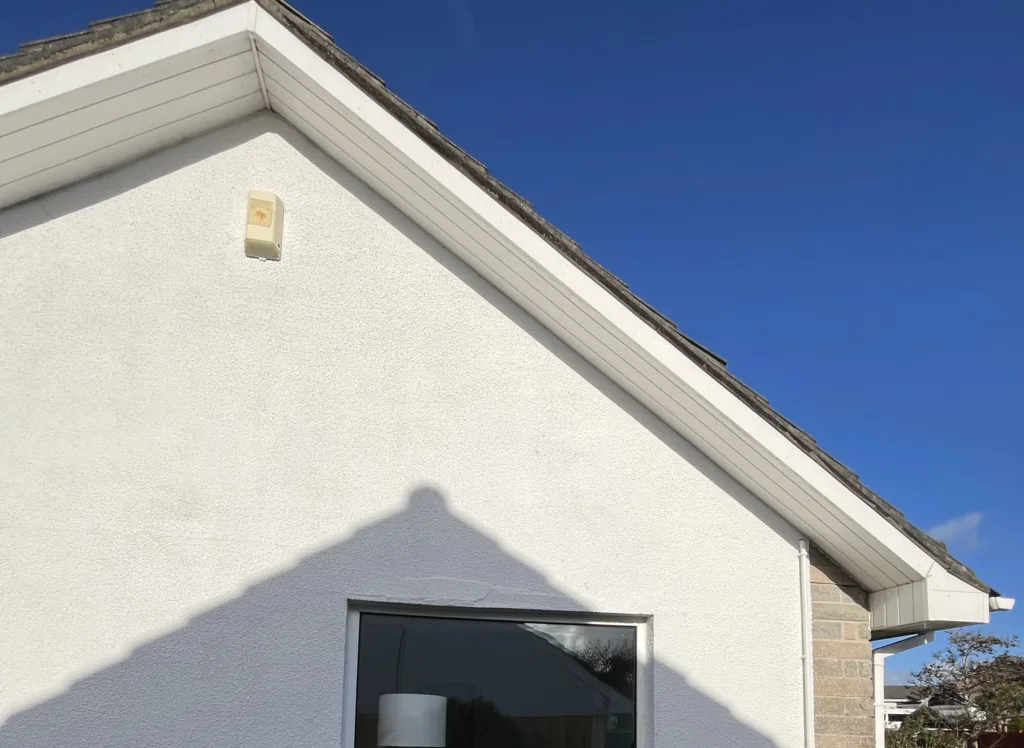
Old alarm panels have a habit of outstaying their welcome. Whether a system has been replaced, upgraded, or simply switched off and left sitting there, the hardware and wiring that remain can create real problems further down the line – particularly when a property is going through renovation. That was the situation at this Newquay property, where an inactive alarm panel and its power outlet needed to be properly decommissioned as part of a wider programme of electrical works.
The alarm system had been dormant for some time. Rather than leave the panel on the wall until the last minute and deal with it as an afterthought, the decision was made to remove it properly at the right stage of the project. That kind of joined-up thinking tends to make everything else run more smoothly – trades working on the walls afterwards don’t have to work around equipment that shouldn’t be there, and there’s no question about whether anything behind the plaster has been dealt with.
So what does decommissioning actually involve? It’s worth explaining, because it’s a job that’s easy to underestimate. Taking the panel off the wall is the easy part. The supply cabling running back from that panel to the consumer unit is what needs careful attention. Simply cutting the wires and leaving them concealed in the wall isn’t an acceptable outcome – not from a safety standpoint, and not from a practical one either. Abandoned cabling with unterminated ends buried in the structure of a building is exactly the sort of thing that creates uncertainty for anyone who comes to work on that property in the future. Surveyors, other electricians, future owners – none of them should have to question what’s live and what isn’t.
The correct approach, and the one taken here, is to disconnect the supply, pull the cabling back as far as reasonably practicable, and terminate it safely. In this case, the supply wiring was traced back and terminated within the loft space above – well away from the wall locations where the panel and outlet had been sited. Once the hardware was removed and the cabling dealt with, the wall surfaces were left electrically clean, with no hidden conductors and no ambiguity.
The power outlet that sat alongside the alarm panel was removed under the same scope of work, following the same principle. Disconnect, pull back, terminate safely. It’s not complicated, but it does need doing properly.
One thing that often gets overlooked is the distinction between a system being switched off and a system being decommissioned. An alarm panel that’s been disabled at the keypad or the panel itself still has a live supply running to it until someone physically removes and terminates that cabling at the circuit level. The circuit is still there, even if nothing connected to it is doing anything. In a property where walls are being opened up and other trades are moving through, that’s not a situation you want to leave in place. Decommissioning properly removes the circuit rather than just silencing it.
Properties accumulate redundant electrical installations over the years. Old alarm systems, defunct circuits, cabling that once served equipment long since removed – it builds up gradually, and it tends to surface at inconvenient moments if it hasn’t been dealt with at the right time. Working through a property and removing what’s no longer needed is one of those jobs that pays dividends later, even if it doesn’t feel particularly dramatic at the time.
For this Newquay property, getting the alarm panel decommission completed at the right stage of the project meant the walls could be made good without any lingering electrical questions. The supply was terminated off cleanly in the loft, the panel and outlet came down, and the locations were left ready for the decorating trades to follow on without any complications.