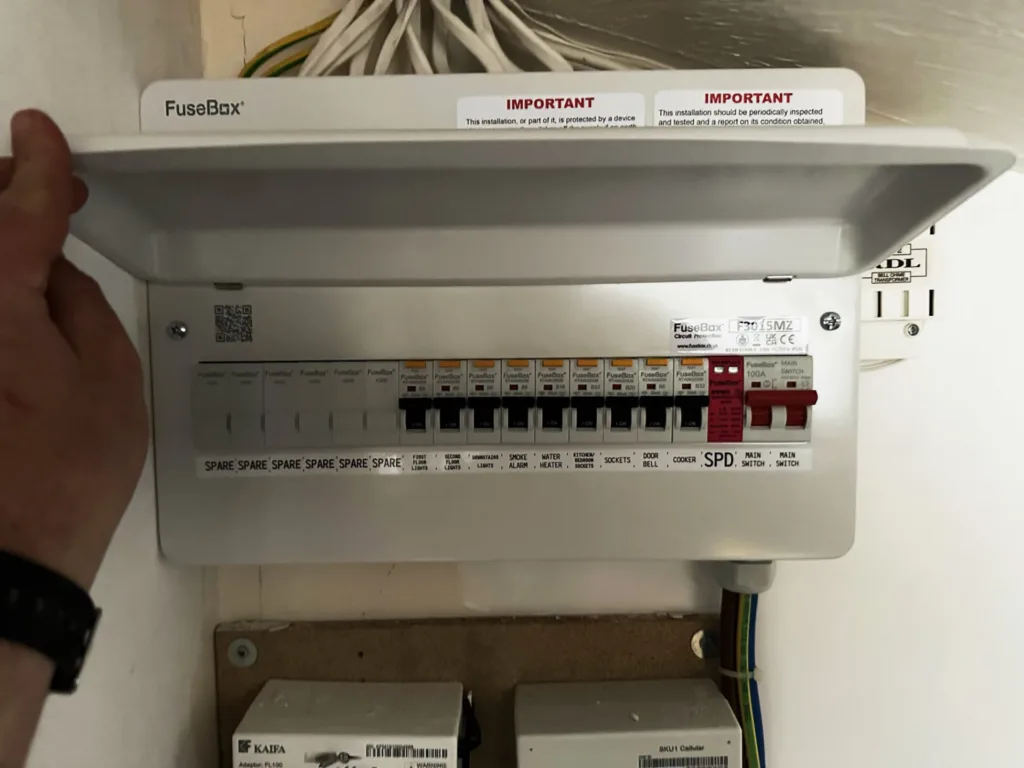
The starting point for this job was an unsatisfactory Electrical Installation Condition Report – the kind of result that needs properly addressing rather than leaving to sit. An EICR had been carried out on the property, and the report made it clear: the existing installation didn’t meet the standards required under the current 18th Edition wiring regulations. A consumer unit replacement was identified as the central piece of remedial work needed to bring things in line.
Replacing a consumer unit that’s come up in an EICR isn’t just about pulling out the old board and putting a new one in. There’s the physical installation, associated cabling upgrades, testing across every circuit in the property, certification, and Building Control notification – all of which need to be done correctly for the work to be properly recorded and compliant.
A FuseBox 15-way RCBO consumer unit was installed in place of the existing board. This unit includes an integrated Surge Protection Device (SPD) – a requirement under 18th Edition Amendment 1, and something that provides real, practical protection for the electronics connected within the property. Voltage fluctuations and power surges from the grid can cause damage to appliances and electronics in ways that aren’t always immediately apparent, so having that protection built into the board addresses the risk at the point where the supply enters the property.
Unlike older split-load consumer units, where groups of circuits share RCD protection, every circuit in this installation is protected by its own individual RCBO. An RCBO – a residual current breaker with overcurrent protection – combines the functions of a residual current device and a circuit breaker in a single module. The practical difference this makes is straightforward: if one circuit trips, the rest of the property stays live. No hunting around trying to work out which half of the board has gone down.
Alongside the board itself, the incoming meter tails were also replaced. These are the cables running between the energy supplier’s meter and the consumer unit, and older properties often have tails that predate current specifications in terms of cross-sectional area or insulation type. Here, they were upgraded to 25mm double insulated cabling – the correct specification for this type of domestic installation. Getting the tails right is part of the job that can easily be overlooked, but leaving them in place means part of the incoming supply sits outside the scope of what’s been improved.
Bodmin, like a fair stretch of Cornwall, has a lot of older housing stock, and properties like this one come up fairly regularly in our work. Consumer unit replacements are a common thread in EICR remedial works across the county – boards that may have been fitted many years ago, before more recent amendments to the wiring regulations came into effect, often don’t reflect what’s expected of a modern domestic installation.
Once the board and tails were in place, every circuit within the property was put through a full round of electrical testing. That testing produces the data needed to complete the Electrical Installation Certificate (EIC) – the formal document confirming the installation has been carried out in accordance with BS 7671 and that all circuits are operating within acceptable parameters. The EIC is the record of the installation itself, and it underpins everything that follows.
That certification then supports the Building Control Notification of Electrical Works – the Part P submission that creates a formal, searchable record of the notifiable electrical work carried out at the property. This is the kind of paperwork that tends to come up when a property is sold or rented, and having it in place means there’s a clear, verifiable record of what was done and when.
With the installation completed and certified, the EICR verification process was carried out to confirm the remedial works had fully resolved the issues identified in the original report. Visual inspections and electrical testing were completed across the installation, working through each of the faults that had been flagged to confirm they’d been properly dealt with. The result was a satisfactory EICR – issued on completion and confirming the installation now meets current standards.
Moving from an unsatisfactory EICR to a satisfactory one isn’t simply a matter of paperwork. The testing and inspection process that produces the final report is what confirms the underlying issues have been addressed, not just replaced or covered over. For the property owner, that document is a clear and defensible record of where the installation stands – whether the property is owner-occupied, being sold, or tenanted.