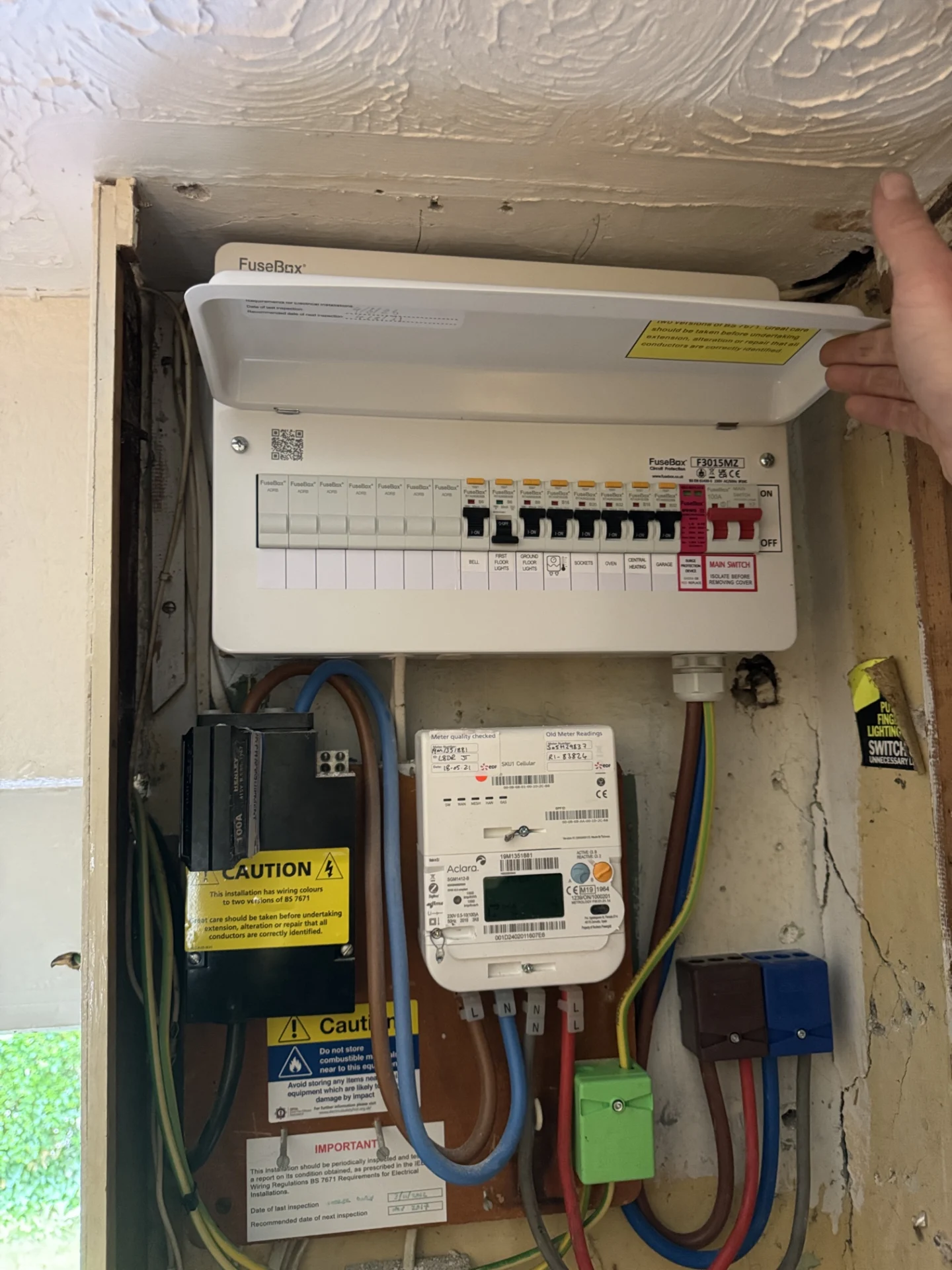
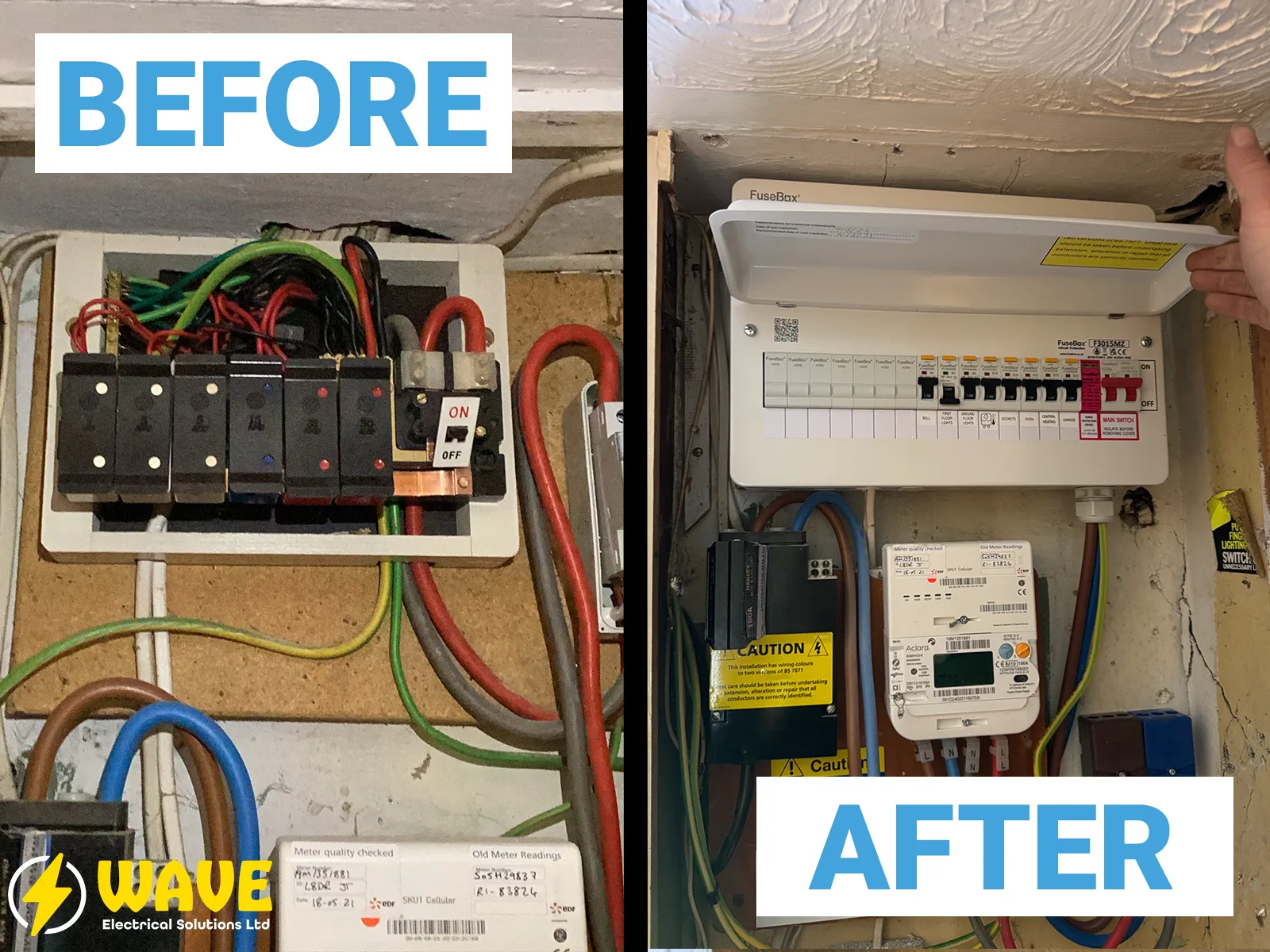
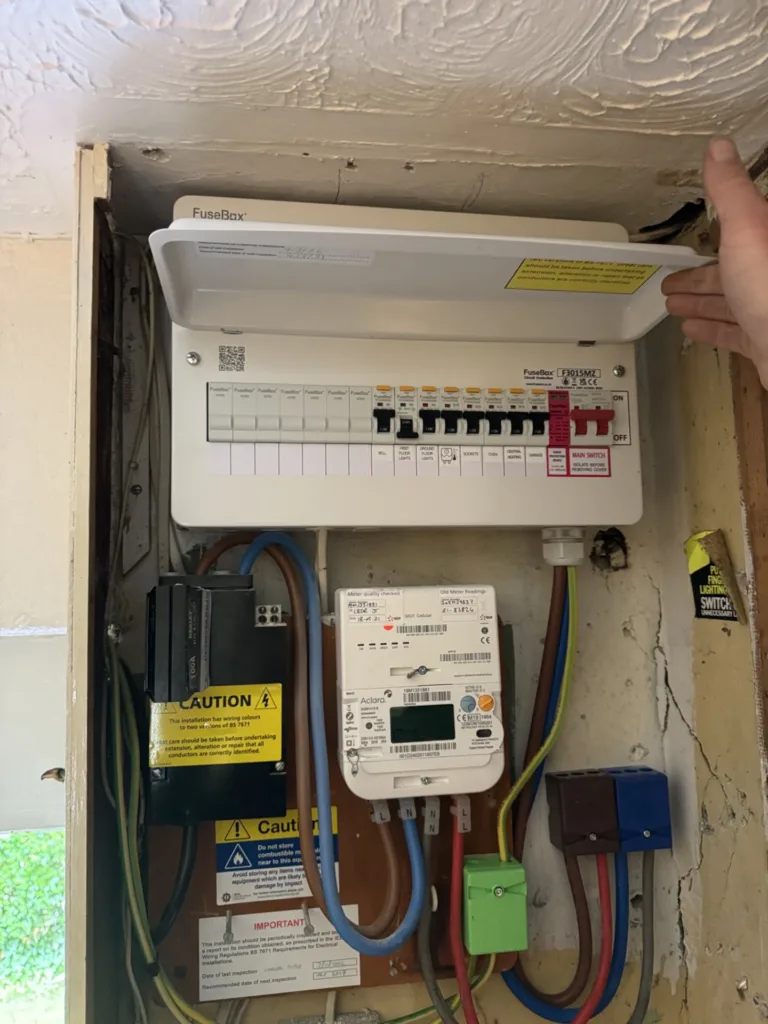
A property in Truro had two ageing consumer units replaced and consolidated into a single fire-rated 18th Edition compliant RCBO consumer unit with integrated surge protection. The incoming meter tails were also upgraded to 25mm double-insulated cabling, bringing the whole installation in line with current wiring regulations.
Some older properties end up with more than one consumer unit – it often happens when extensions are added, circuits are expanded over time, or a previous electrician took the path of least resistance rather than doing the job properly. It’s not unusual, but it does create complications. Running two separate boards means two sets of protection devices to maintain, less flexibility across the installation, and a setup that’s increasingly out of step with modern wiring standards.
This job in Truro was a good example of exactly that situation. The property had two existing consumer units – DB1 and DB2 – each supplying a collection of circuits throughout the building. Neither board came close to meeting the current 18th Edition of the IET Wiring Regulations, and the incoming meter tails were well below the standard expected on an installation of this type. The customer wanted everything sorted properly, so we put together a scope of works that would consolidate both boards into a single, fully compliant unit and bring the rest of the incoming supply up to scratch at the same time.
Why Consolidation Makes Sense
Having two consumer units isn’t automatically a problem in terms of day-to-day function, but it does create a less than ideal setup from a safety and compliance perspective. With circuits split across two boards, you lose the benefit of having all your protection devices in one place. Fault-finding becomes more involved, circuit labelling can be confusing, and you’re essentially maintaining two separate points of control for something that should really be unified.
Bringing everything into one board makes the installation cleaner, easier to manage, and far better placed for any future electrical work. It also gives the opportunity to fit proper modern protection across every circuit in the property – which in this case meant a full complement of RCBOs rather than the older RCD and MCB arrangements that were in place.
The New Consumer Unit
The replacement board is a fire-rated 15-way RCBO consumer unit, installed to comply with the 18th Edition Wiring Regulations. Each circuit in the property now has its own individual RCBO – that stands for Residual Current Breaker with Overcurrent protection – which combines the functions of an RCD and an MCB into a single device per circuit.
The practical difference this makes is significant. On an older board with a shared RCD, a fault on one circuit trips the RCD and takes out everything else it covers at the same time. You lose your lighting while you’re trying to find a torch to locate the fault, or the freezer goes off along with a faulty appliance you hadn’t even noticed. With individual RCBOs, a fault on one circuit trips only that circuit. Everything else stays on.
The consumer unit itself is fire-rated, which matters in the context of the 18th Edition regulations. Consumer units in domestic installations are now required to have fire-resistant enclosures – typically metal – to reduce the risk of a fault within the board itself contributing to a fire spreading through the property.
Surge Protection Device (SPD)
The new board also includes an integrated Surge Protection Device, commonly referred to as an SPD. This is now a requirement under the 18th Edition in most domestic and commercial installations, and for good reason.
Voltage fluctuations and power surges from the grid are more common than most people realise. They can be caused by lightning strikes, switching events on the network, or faults upstream from the property. When a surge travels through the supply and into the building’s wiring, it can damage or destroy connected electronics – televisions, computers, smart home devices, white goods with electronic controls, and pretty much anything else that’s plugged in.
An SPD sits at the consumer unit and intercepts those surges before they reach the circuits and the equipment connected to them. It doesn’t eliminate the risk entirely, but it significantly reduces the potential for damage. As more properties fill up with expensive electronics and sensitive equipment, having SPD protection at the board level is becoming increasingly relevant.
Upgrading the Meter Tails
The incoming meter tails – the cables that connect the electricity meter to the consumer unit – were also replaced as part of this job. The existing tails weren’t sized appropriately for the installation, so we upgraded them to 25mm double-insulated cabling.
Meter tails are the main feed into the property’s electrical system, and if they’re undersized they can introduce resistance into the supply, generate heat under load, and potentially cause issues with the performance of the installation. Upgrading them at the same time as the consumer unit makes sense from a practical standpoint – it means the whole incoming supply has been dealt with properly rather than fitting a new board onto an inadequate feed.
Double-insulated tails have an additional layer of insulation compared to standard single-insulated cables, which provides extra mechanical protection in the area around the meter and consumer unit where tails are often routed through confined spaces.
18th Edition Compliance
The 18th Edition of the IET Wiring Regulations is the current edition of the standard that governs electrical installations in the UK. It was introduced in 2018 and has since been updated with amendments that tightened requirements around areas like surge protection and arc fault detection.
An installation being “18th Edition compliant” doesn’t just mean it’s legal – it means it reflects current best practice in terms of how circuits are protected, how equipment is specified, and how the overall installation is put together. Properties with older consumer units are often running boards that were installed under previous editions of the regulations, meaning they lack some of the protections that are now considered standard.
This job in Truro took an installation that had evolved in a piecemeal way over the years and brought it back to a coherent, properly protected state. Two outdated boards are now one – circuits are individually protected, surge protection is in place, and the incoming supply has been upgraded to match.