An Electrical Installation Condition Report – commonly known as an EICR – is a formal inspection that assesses the condition of an existing electrical installation. When observations are raised, they’re coded by severity, and acting on them isn’t just good practice, it’s often a requirement, particularly in rented properties or where insurance or mortgage conditions apply. This job in Newquay came through exactly that route, with a number of observations from a previously completed EICR that needed addressing.
The main focus of the work was replacing the existing consumer unit. Consumer units – the box that houses your circuit breakers and RCDs – have developed considerably over the years, and older installations often contain equipment that no longer meets the current standard, which in the UK is the 18th Edition of the Wiring Regulations (BS 7671). Beyond compliance, there’s a practical element too. A consumer unit that doesn’t offer adequate protection across every circuit is a real limitation, both in terms of safety and convenience.
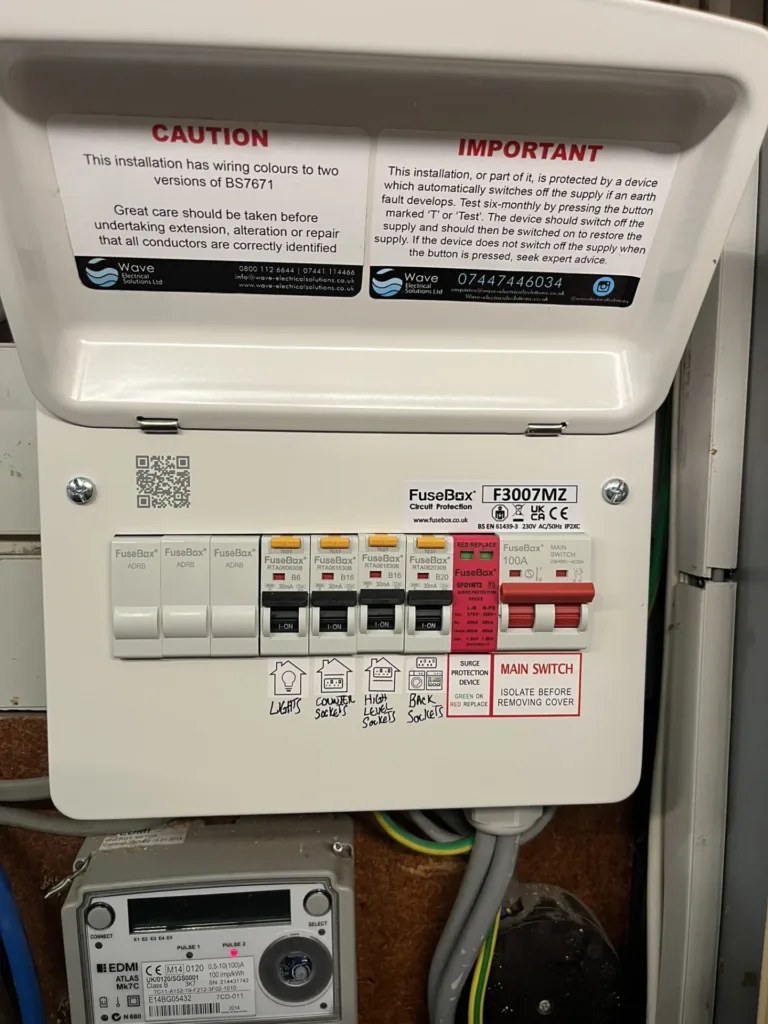
The replacement unit fitted here was a 7-way RCBO consumer unit. The distinction between a traditional split-load board and a fully RCBO-equipped unit is worth explaining. In a split-load setup, circuits are grouped together and share a single RCD. That means if a fault develops on one circuit, the RCD protecting that group trips, taking out every circuit connected to it – lights, sockets, whatever else sits behind it. An RCBO unit works differently. Each circuit has its own combined overcurrent and residual current protection built into a single device. A fault on one circuit trips only that circuit, leaving everything else unaffected. For homeowners, that’s a meaningful difference. For landlords managing occupied properties, it’s even more relevant.
Alongside the unit itself, the incoming meter tails were upgraded to 25mm double-insulated cabling. Tails are the cables that run between the meter and the consumer unit, carrying the full incoming supply. Older installations often have tails that fall short of current requirements, either in terms of size or insulation spec. Upgrading them as part of a consumer unit replacement is standard practice and forms part of making sure the whole incoming arrangement is fit for purpose.
The new consumer unit also includes an integrated Surge Protection Device, or SPD. This is now a requirement under the 18th Edition for most domestic and commercial installations. The SPD’s role is to divert transient voltage spikes – caused by things like lightning strikes on the distribution network, or switching events from the grid – away from the connected circuits. Modern homes are full of sensitive electronics, from smart home devices and computers to washing machines and boilers with digital controls, and a voltage surge can cause damage that isn’t always immediately obvious. Having an SPD built into the consumer unit means that protection is always in place at the point of supply, without needing separate devices fitted elsewhere.
With the consumer unit work completed, attention turned to the remaining observations from the EICR. A main bonding clamp was installed on the incoming water supply, positioned within 300mm of the main stopcock as required. Main bonding is a fundamental part of any electrical installation – it connects the main metallic services entering the building to the earth of the electrical system, reducing the risk of electric shock if a fault causes those pipework runs to become live. Where required, the associated cabling was routed and contained within PVC trunking to give a neat, secure finish.
Two pull cord light switches were also replaced – one in the back room, one in the toilet. Both were showing signs of thermal damage, which is one of the more straightforward observations an EICR can flag but one that really does warrant prompt attention. A switch exhibiting heat damage has, at some point, been carrying more current than it should have, or has simply degraded to the point where it’s no longer performing reliably. Replacing them removes that risk entirely.
Finally, a metal back box associated with a double socket outlet in the window sill was re-secured. Over time, fixings can work loose, particularly in timber surrounds where movement and moisture can affect the fit. Getting it properly secured again restores the socket to a safe, stable condition.
Taken together, the work carried out here is a good example of what EICR remedial works tend to look like in practice – a core upgrade forming the backbone of the project, supported by a handful of targeted fixes that address specific observations. The consumer unit installation in particular brings this Newquay property’s electrical installation into line with current regulations, with the added benefit of individual circuit protection and surge protection that older setups simply can’t offer.