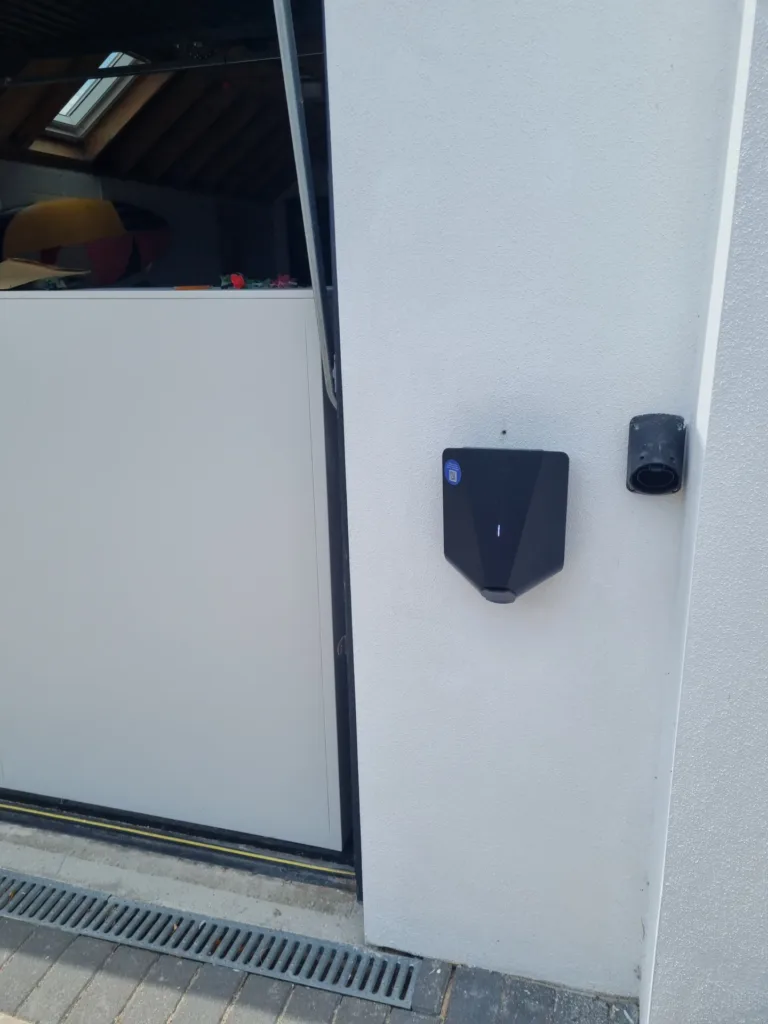
Fitting an EV charger at a holiday let is a different proposition to installing one at a private home. Not in terms of the electrical work – that side follows the same approach – but in terms of what the owner actually needs the charger to do. A domestic charger serves the household. A holiday let charger serves a rotating stream of guests, and that changes the priorities fairly significantly.
The owner of this Cornwall property had a clear requirement: guests needed to be able to charge their vehicles, but the associated electricity costs needed to be covered directly by those using the charger rather than absorbed into the rental overheads. Building EV charging into a nightly rate is an imprecise way of handling it – some guests will barely use the charger, others might charge heavily for several days running. A usage-based billing system is a far cleaner solution.
The charger selected for this installation was the Easee, a wall-mounted unit with a compact, angular build and a more distinctive look compared to a lot of charge points currently on the market. Rather than having a fixed cable attached, the Easee has an integrated Type 2 socket – guests connect using their own lead or one provided at the property. The unit was installed on the exterior wall adjacent to the garage, positioned to give unobstructed access from the driveway.
The feature that made the Easee the right fit here is its compatibility with Tap Electric, a payment platform built for charge point owners who want to bill users for their electricity consumption. The process for guests is fairly simple: a QR code on the front of the unit directs them to the Tap Electric interface on their phone, where they start a session and pay for what they use at the rate set by the property owner. No key to hand over with the rental, no physical access card, and no requirement for the owner to approve or manage sessions individually. Pricing is configured through the platform and can be adjusted remotely whenever running costs change.
That level of automation is genuinely useful for a property that turns over different guests week to week. Session records and payment data sit within the platform, so the owner has full visibility of charger usage without needing to be on site. From the guest’s perspective, starting a session works much the same way as using a public charge point – scan, connect, charge. For anyone who’s used a public charger before, it’s a familiar enough process.
As EV ownership continues to grow, the expectation of being able to charge during a holiday let stay is shifting from a bonus to something closer to a standard amenity. A setup that handles billing automatically means the charger can function as a genuine facility rather than something the owner has to manage manually around each changeover.
The electrical installation behind the charger follows standard practice for a new EV charger circuit. A dedicated 40A circuit was run from the consumer unit to the charger position, with a new MCB added to the board to protect the circuit independently. The existing RCD was replaced with a Type A unit – required for EV charger installations because of the fault current types that charging equipment can generate, which a Type AC device may not reliably detect. A load monitoring device was also incorporated, watching the property’s total electrical demand in the background and automatically managing the charger’s output if the supply approaches its limits. The car continues charging throughout – the load monitor just adjusts the rate relative to what else is running in the property at the time.
With the electrical work done and the circuit tested, an Electrical Installation Certificate was produced. The Tap Electric platform was then configured with the owner’s pricing, the Easee commissioned, and the system confirmed as fully operational before handover.