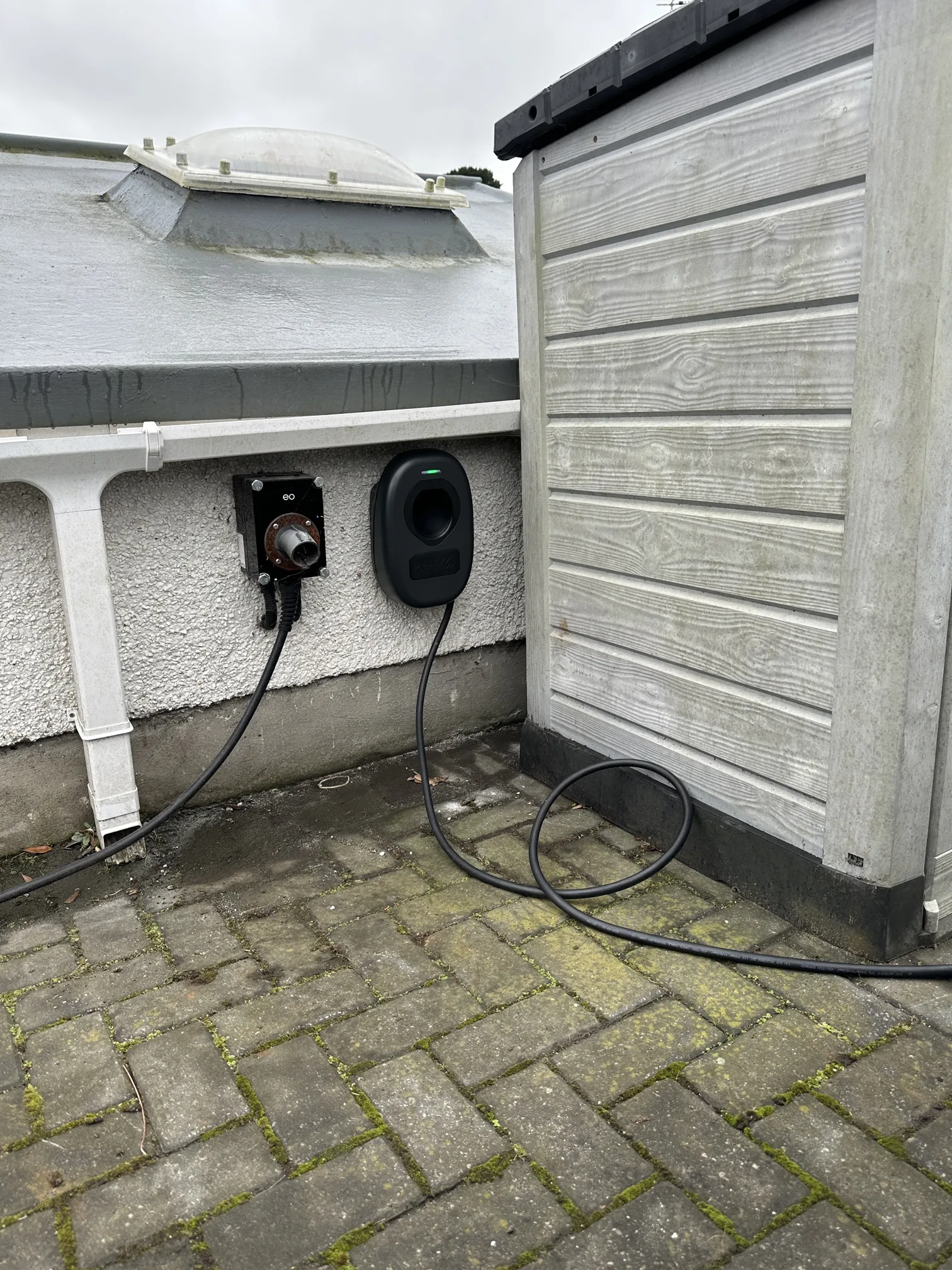
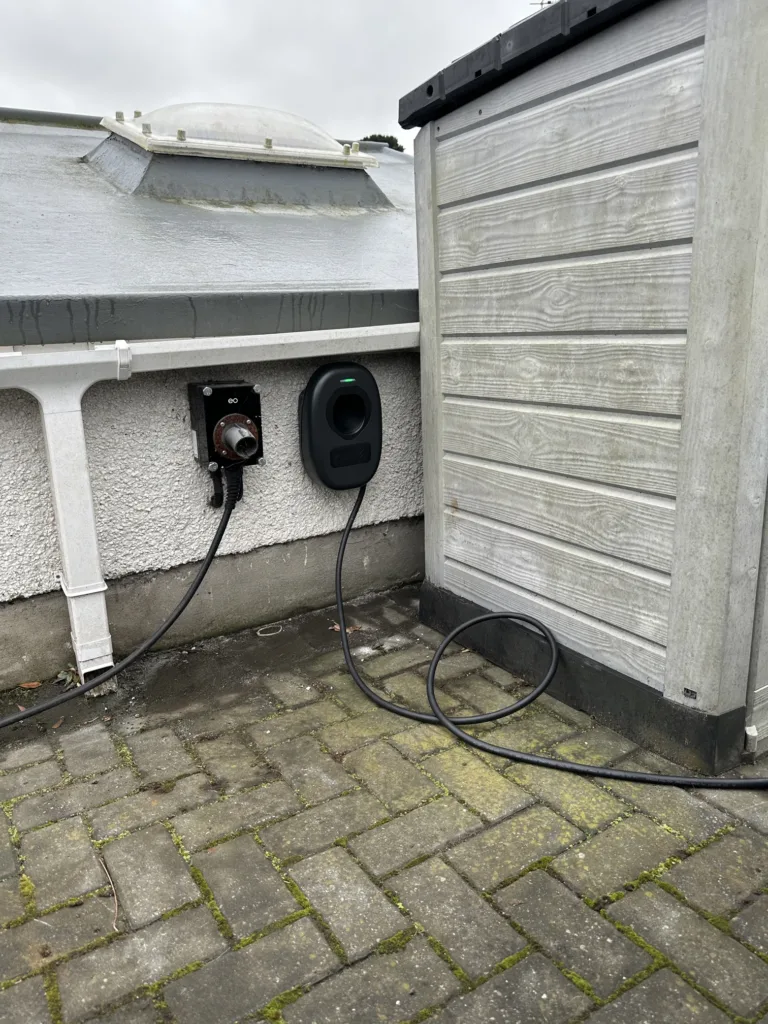
Installing a 7.4kW Sync EV charge point for a Falmouth property, complete with load monitoring technology to prevent electrical system overload and protect the existing infrastructure.
The transition to electric vehicles often means homeowners need to upgrade their electrical setup to accommodate the additional demand. When a Falmouth property owner purchased a new Mitsubishi with Type 2 charging capability, they already had a Type 1 charger installed for another vehicle. Rather than replacing the existing unit, they wanted a second charge point that could work alongside their current setup without compromising the property’s electrical capacity.
The installation centred around a 7.4kW tethered Sync EV charge point, mounted on the exterior wall at the front of the property. A tethered unit comes with a fixed cable attached permanently to the charging station, which means there’s no need to carry a separate charging cable or worry about it being stolen. The cable stays with the unit, ready to use whenever needed.
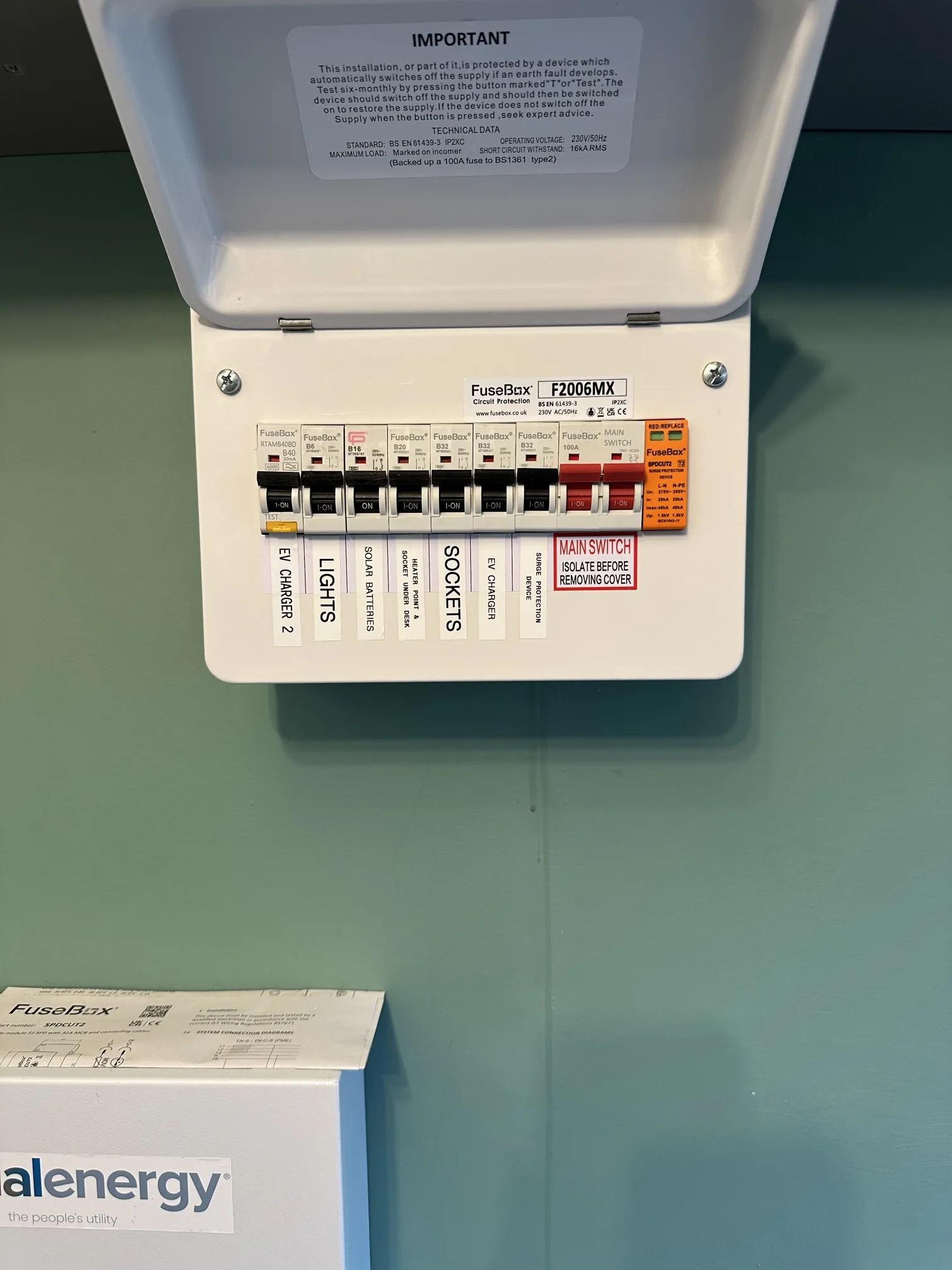
Power distribution required careful planning. The charge point draws its supply through a 40A circuit breaker fitted within the existing office sub-main consumer unit. This positioning allowed for proper circuit protection whilst integrating seamlessly with the property’s current electrical configuration. Working with an existing sub-main meant assessing the available capacity and confirming that the additional load could be supported safely.
One of the main considerations for any EV charger installation is preventing electrical system overload. Properties have finite electrical capacity, and adding a high-draw appliance like an EV charger can push systems beyond their limits if not managed properly. To address this, a load monitoring device was incorporated into the installation. This device continuously tracks the electrical consumption across the property in real-time, measuring how much power is being drawn by all circuits and appliances.
When the property’s overall electrical demand approaches maximum capacity, the monitoring device communicates with the EV charge point and automatically reduces its charging rate. This dynamic adjustment happens seamlessly in the background, protecting the main electrical infrastructure from overload whilst still allowing the vehicle to charge. The homeowner doesn’t need to manually manage anything or worry about tripping circuits during peak usage times.
Installing the load monitoring system involved running an external grade data cable from the charge point location to the main consumer unit. The cable route passed through the loft space, keeping it hidden from view whilst maintaining the necessary connection between the two points. Data cables for load monitoring need to withstand various environmental conditions, particularly when any section runs externally, which is why appropriate external grade cabling was specified for this installation.
The routing through the loft required navigating existing building structures, insulation and other services already present in that space. Care was taken to secure the cable properly and avoid any interference with other systems. The connection at the main consumer unit allows the monitoring device to read the overall electrical load accurately, providing the information needed to adjust the charge point’s output when required.
Circuit testing formed a significant part of the installation process. Every new electrical circuit needs thorough testing to verify it’s been installed correctly and operates safely. The testing covered insulation resistance, continuity, earth fault loop impedance and polarity, amongst other checks. These measurements confirm that the circuit meets all relevant electrical regulations and will function reliably over time.
Following successful testing, an Electrical Installation Certificate was produced. This certificate documents the work carried out, the test results obtained and confirms compliance with current wiring regulations. It’s a legal requirement for notifiable electrical work and provides the property owner with formal evidence that the installation has been completed to the required standards.
Building Control notification was also submitted for this installation. Certain electrical works, including EV charger installations, fall under Building Regulations and need to be reported to the local authority. The notification process involves submitting details of the work and the accompanying Electrical Installation Certificate, which then gets registered with Building Control. This creates an official record of the installation and adds to the property’s compliance documentation.
Having two EV chargers at the property gives the homeowners flexibility in their charging arrangements. The existing Type 1 charger continues to serve one vehicle whilst the new Type 2 unit handles the Mitsubishi. This dual setup means both cars can be charged without needing to swap cables or manage scheduling between vehicles, making the whole process more convenient for daily use.
The load monitoring technology adds an intelligent layer to the installation. Rather than simply installing a charge point and hoping the property’s electrical system can cope, the monitoring device actively manages demand. During periods of high household electricity use, such as when multiple appliances are running simultaneously, the EV charger will automatically reduce its output to prevent overload. When overall demand drops, the charger can ramp back up to full speed.
This approach protects the property’s electrical infrastructure from stress and potential damage. It also means the homeowners can use their household appliances normally without constantly thinking about whether the EV is charging and whether that might cause problems. The system handles everything automatically, balancing the various electrical demands across the property.
Tethered charge points offer particular advantages for home installations. The fixed cable is always there when needed, eliminating the risk of forgetting to bring a charging cable home or having it borrowed by another household member. The cable is also secured to the unit itself, making theft considerably less likely compared to portable cables that might be left lying around. For properties where the charge point will be used primarily by one or two regular vehicles, a tethered setup often proves the most practical choice.
The 7.4kW charging speed provides a good balance between charging time and electrical demand. It’s fast enough to fully recharge most electric vehicles overnight, even from a low battery level, whilst not requiring the kind of heavy electrical infrastructure needed for higher-powered chargers. For typical home use patterns, 7.4kW charging capacity handles daily driving needs comfortably.
Positioning the charge point at the front of the property placed it conveniently close to where the vehicles are parked. External wall mounting keeps the unit weatherproof and accessible whilst minimising the cable run needed to reach the car. The outdoor installation also means the charger doesn’t take up internal space or require bringing cables through the house.
The integration with the existing office sub-main consumer unit demonstrated how new electrical installations can work with older infrastructure when properly planned. Rather than requiring a complete electrical system overhaul, the work built upon what was already there, adding the necessary protection and monitoring to make it safe and functional. This approach often proves more cost-effective whilst still delivering a fully compliant installation.
Electrical regulations continue to evolve, particularly around EV charging installations as they become more common. Current standards require proper earthing arrangements, residual current device protection and adequate cable sizing for the expected load. All these elements were addressed during the installation, with testing confirming that every aspect met the required specifications.
The completion of this installation means the property is now set up to handle two electric vehicles efficiently. The load monitoring system provides ongoing protection, the tethered cable offers convenience and security, and the proper certification gives peace of mind that everything has been done correctly. As electric vehicle adoption continues to grow, installations like this one will become increasingly common, helping homeowners make the transition to electric transport whilst maintaining safe, reliable electrical systems.