Working in a Quintrell Downs property, we installed three pendant light fittings throughout a hallway to create a more welcoming entrance space. The installation involved connecting the new lights to the existing circuit and integrating them with the current two-way switching system, allowing the homeowner to control all hallway lighting from multiple points throughout their home.
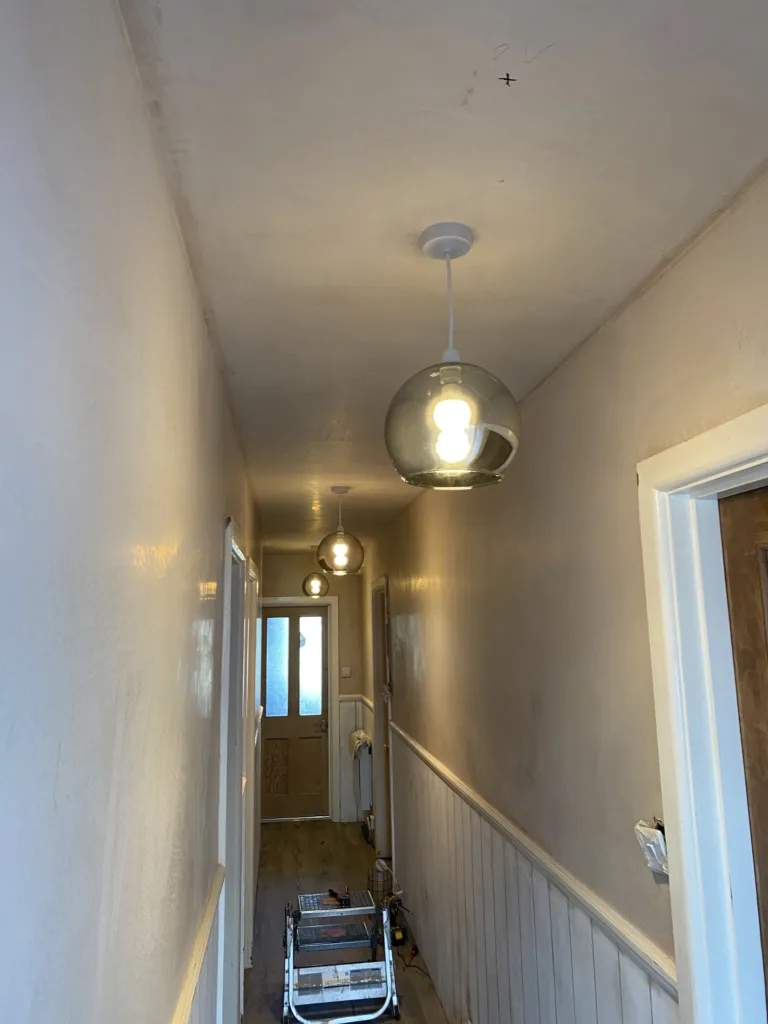
Hallways often get overlooked when it comes to lighting design, yet they’re the first space you encounter when entering a home and the transitional area you pass through multiple times daily. This Quintrell Downs property owner recognised the potential to transform their entrance corridor from a purely functional space into something more inviting. Rather than relying solely on a single central ceiling light, they chose to add three pendant fittings strategically positioned along the hallway’s length.
The project began with a thorough assessment of the existing lighting circuit. Before any installation work could commence, we needed to verify the circuit’s capacity and condition. Adding three additional light fittings to an established circuit requires careful consideration of load capacity, cable sizing, and compliance with current wiring regulations. After confirming that the existing circuit could safely accommodate the additional lighting points, we planned the cable routes from the central lighting position to the new pendant locations.
The homeowner had already selected their preferred light fittings before our arrival, which is becoming increasingly common as people take a more hands-on approach to their interior design choices. This arrangement works well for many customers who have specific aesthetic visions for their homes. However, it does mean we focus purely on the electrical installation aspect while the homeowner takes responsibility for the suitability and quality of the fittings themselves. In this case, the chosen pendants would be positioned at both ends of the hallway and would operate alongside the existing central light, creating a balanced lighting scheme throughout the corridor.
Running new cables through an occupied home presents its own set of challenges. Nobody wants their walls unnecessarily damaged or their daily routine disrupted more than necessary. For this installation, we worked with the understanding that wall channeling would be prepared in advance by others, which streamlined our work considerably. This collaborative approach between trades isn’t uncommon in renovation projects where multiple contractors are involved. The prepared channels allowed us to run the necessary cabling from the existing lighting circuit to each of the three new pendant positions with minimal disruption to the property’s fabric.
The electrical work itself involved more than simply connecting wires to light fittings. Each pendant needed to be properly supplied from the existing circuit, with the cabling concealed within the wall channels to maintain a clean, professional appearance. The positioning of these lights required precision – too close together and they’d create harsh overlapping pools of light, too far apart and you’d end up with shadowy gaps between them. The homeowner’s chosen locations worked well for the space, distributing light evenly throughout the hallway while complementing the existing central fitting.
Integration with the existing two-way switching system was another important consideration. The property already had two-way switches controlling the hallway lighting, allowing the lights to be operated from multiple points. When you’re adding new light fittings to a hallway, maintaining this functionality is crucial. You don’t want to create a situation where some lights can only be controlled from one location while others operate differently. We wired the new pendants to work in conjunction with the central light, all controlled by the same two-way switching arrangement. This means the homeowner can turn all their hallway lighting on or off from either end of the corridor, which is particularly useful in a busy household.
Part of the installation work included renewing the faceplates on the existing switches. Over time, switch faceplates can become discoloured, worn, or simply dated in appearance. Since we were already working on the lighting circuit, it made sense to refresh these visible components. We fitted standard white plastic faceplates to match the property’s existing electrical accessories, giving the switches a clean, updated appearance that complements the new lighting arrangement.
The technical aspects of this installation required careful attention to circuit protection, cable sizing, and termination methods. Every connection must be secure and compliant with current wiring regulations. When you’re working with existing circuits, you’re not just adding new components – you’re integrating them into an established electrical system. The cable routes needed to be planned to avoid potential damage from future renovations or maintenance work. Each pendant’s ceiling rose was securely fixed and properly terminated, with appropriate strain relief for the pendant flexes. These details might not be immediately visible to the homeowner, but they’re fundamental to a safe, long-lasting installation.
Lighting design in residential properties has shifted considerably over recent years. Where once a single central ceiling light was considered adequate for a hallway, homeowners now recognise the value of layered lighting schemes. Multiple pendants along a corridor create visual interest while providing more practical illumination. They eliminate the harsh shadows that a single central light can cast and offer more flexibility in terms of ambiance. You can choose different bulb types or wattages for different effects, and the spacing of multiple fittings naturally guides the eye along the hallway’s length.
From a practical standpoint, improved hallway lighting has benefits beyond aesthetics. Better visibility in transitional spaces reduces the risk of trips and falls, particularly important for households with young children or older residents. It makes finding keys, checking post, or simply moving through the space at night considerably easier. The ability to control all the hallway lights from multiple points means you’re not fumbling in the dark or having to walk the length of the corridor to turn lights off.
The work in Quintrell Downs reflects a growing trend towards more considered lighting schemes throughout the home. Homeowners are increasingly willing to invest in electrical upgrades that improve both functionality and atmosphere. A well-lit entrance sets the tone for the entire property, and spending time in a thoughtfully illuminated space is simply more pleasant than navigating poorly lit corridors. The installation process itself was straightforward thanks to the prepared channeling and clear communication with the homeowner about their requirements.
Working with client-supplied fittings always requires clear understanding about where our responsibility lies. We provide the electrical installation expertise, the proper circuit integration, the compliant cabling work, and the secure fixing of components. The fittings themselves, their design suitability, their quality, and their performance are matters for the homeowner and their supplier. This division of responsibility works well provided everyone understands it from the outset. Our role is to make those chosen fittings function safely and effectively within the property’s electrical system.
The result transforms the hallway from a single-lit corridor into a more deliberately designed space. The three pendants create a rhythm along the ceiling while providing better, more evenly distributed light throughout the area. The updated switch faceplates complement the refreshed lighting scheme, and the homeowner has the convenience of controlling everything from multiple points. These kinds of installations demonstrate how targeted electrical work can significantly improve both the functionality and feel of a home without requiring extensive renovation. Sometimes it’s the transitions between rooms that deserve as much attention as the rooms themselves.