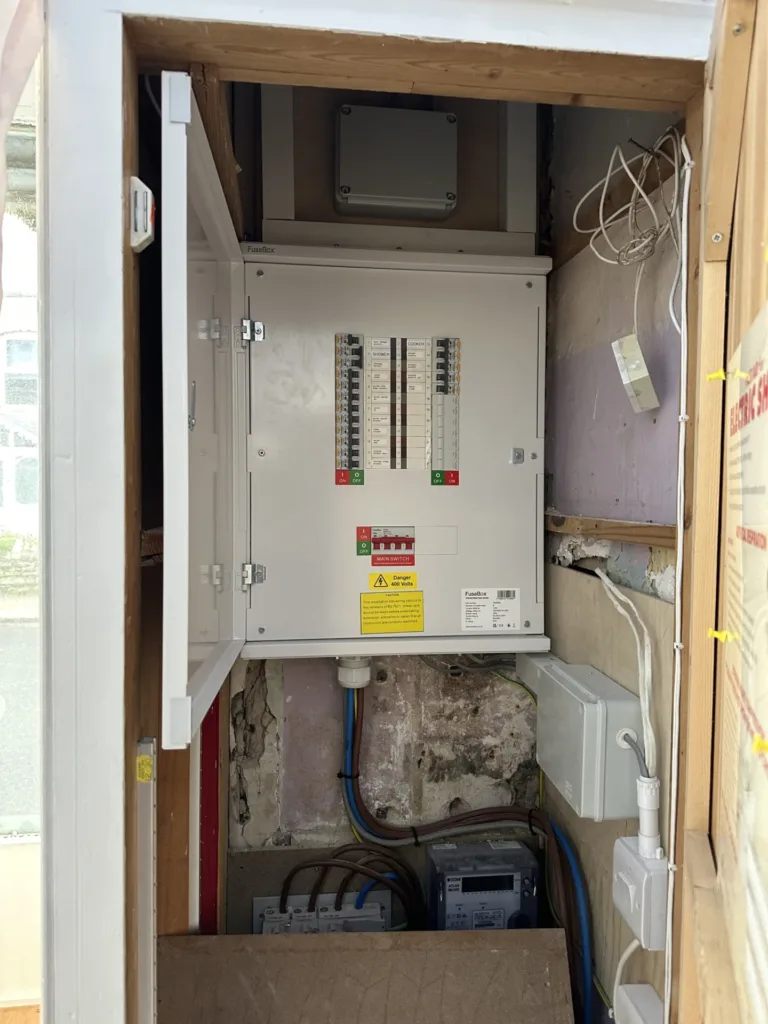
Running a commercial kitchen on a single-phase supply is something a lot of food businesses find they grow out of fairly quickly. As equipment is added – extra fridges, cooking appliances, dedicated prep areas – the demand placed on a single consumer unit starts to push against its limits. For this Newquay premises, the existing 8-way single-phase board had reached the point where it simply couldn’t accommodate what the business needed, either now or down the line. The solution was a full 3-phase consumer unit upgrade.
The work centred on replacing the original board with a 24-way 3-phase commercial consumer unit, which effectively provides 24 single-phase circuits across three phases. That’s a significant step up in capacity – and the key thing here wasn’t just solving the immediate problem, it was giving the business room to expand its electrical installation without having to revisit the distribution board again. Future circuits can be added without any major structural changes to the setup, which matters when you’re running a busy kitchen environment and can’t afford prolonged downtime.
Before the new board could go in, the incoming meter tails needed upgrading to 25mm double-insulated cabling. The original tails were undersized relative to what a 3-phase installation demands, so this was a necessary part of the job rather than an optional addition. Getting the supply infrastructure right at this stage is what allows everything downstream to perform as it should.
Each circuit within the new consumer unit was protected by an individual RCBO – combining overcurrent and residual current protection in a single device. This approach offers a meaningful practical advantage in a commercial setting: if a fault develops on one circuit, it trips independently without taking down the rest of the board. For a kitchen that relies on refrigeration running continuously alongside cooking equipment and general power, that kind of circuit-level protection can make a real difference to how disruptions are managed.
All existing circuits were extended as required to reach the new board position, and the full installation was tested on completion. An Electrical Installation Certificate was produced to satisfy Building Control notification requirements – something that’s required whenever notifiable electrical work is carried out in a commercial premises and needs to be in order before the work can be signed off.
Alongside the consumer unit installation, a number of associated electrical works were carried out at the same time – including new dedicated socket circuits for the food prep areas, the relocation of existing outlets and a cooker isolator switch, and a dedicated supply for the serving area water heater. These fitted within the wider project scope and were served by the new distribution board, but the consumer unit itself was the foundation everything else was built around.
For commercial kitchens and food businesses thinking about where their electrical installation is heading, the move from single-phase to 3-phase isn’t always straightforward to plan for, but it’s worth getting right early. A properly specified 3-phase board, installed to current regulations with appropriate protection on each circuit, gives a business the flexibility to adapt – whether that’s adding prep equipment, expanding the kitchen layout, or simply accommodating a heavier load than the original installation was ever designed to handle.