Bathroom electrical work might not always sit at the more complex end of the spectrum, but it’s an area where getting things right genuinely matters. The regulations that govern bathroom installations reflect the fact that water and electricity in close proximity require careful handling – and a faulty fitting in a wet room isn’t something to leave for another day.
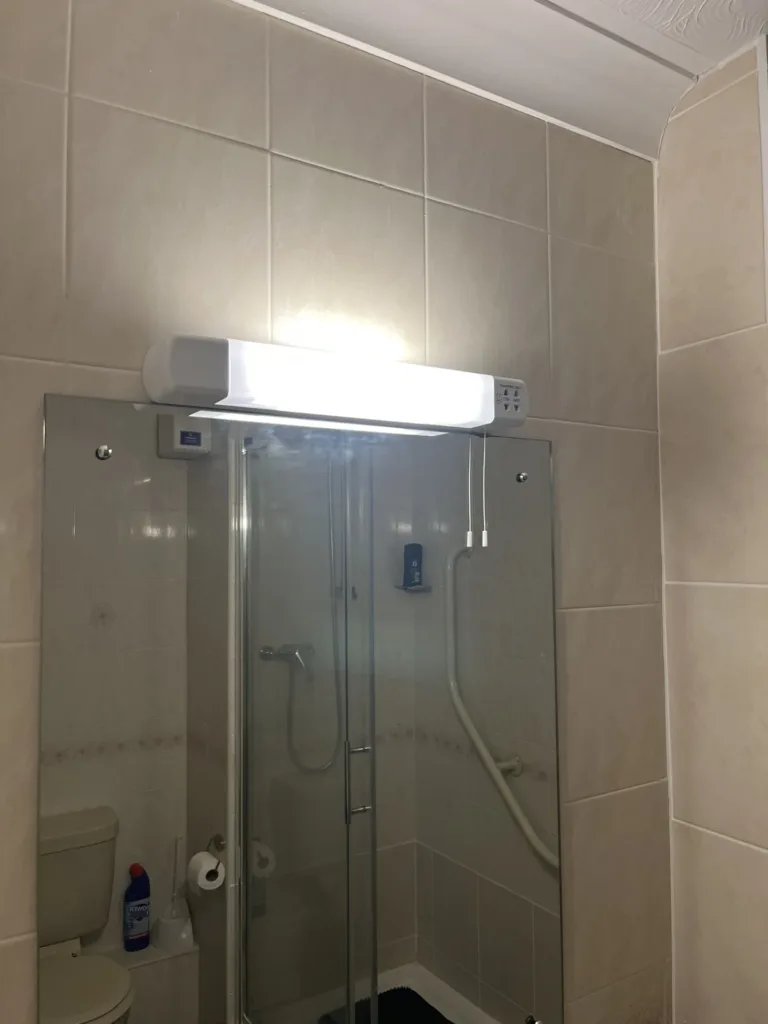
The job here was a shaver light at a property in Newquay that had stopped working. The existing fitting had developed a fault and was no longer functioning, leaving the bathroom without a working light in that spot and without the shaver socket that forms part of the combined unit. A replacement was the obvious solution, so we supplied a new LED dual voltage shaver light and carried out the installation.
Shaver lights serve a fairly specific purpose in UK bathroom electrics. A standard 13-amp socket outlet isn’t permitted inside a bathroom under UK wiring regulations – the risk of electric shock from a full-voltage outlet in a wet room environment is precisely why they’re not allowed in there. A dual voltage shaver socket works differently. It uses an isolation transformer to separate the output circuit from the mains supply and delivers either 115V or 230V output depending on the appliance being used. That isolation is what makes it suitable for a bathroom, and it’s the reason a shaver socket is the correct and legally compliant way to power an electric shaver, toothbrush, or similar small appliance at the bathroom mirror. Without one, there’s simply no safe way to charge or use that kind of appliance in the room.
The unit we supplied is an LED version, and LED has largely become the standard for this type of fitting. Compared to older fluorescent equivalents, LED fittings draw less power, reach full brightness immediately without any warm-up period, and have a considerably longer working life. In a fitting used every day – often mounted in a spot that isn’t particularly easy to access for maintenance – that longevity matters. The light output from a good LED unit also stays consistent throughout its lifespan, which fluorescent tubes couldn’t always claim as they got older. On a day-to-day level, that means reliable, even light directly where it’s needed in the bathroom, without the flicker or gradual fade that can come from an ageing fluorescent.
Bathroom electrical work in the UK falls under Part P of the Building Regulations, which requires this type of work to be carried out by a competent person. One of the things that distinguishes bathroom electrical installation from work elsewhere in a property is the zone classification system. Bathrooms are divided into zones based on their proximity to water sources. Zone 0 refers to the interior of the bath or shower itself. Zone 1 covers the space directly above the shower or bath up to a height of 2.25 metres. Zone 2 extends a further 0.6 metres horizontally beyond the Zone 1 boundary.
Every zone carries a minimum IP rating requirement for fittings installed within it. IP stands for Ingress Protection, and the rating classifies how resistant a product is to solid particles and liquids. In a bathroom where hot showers produce steam daily and water splashes are part of normal use, this isn’t a minor technicality. A fitting with an adequate IP rating for its position will handle that environment reliably over time. One that doesn’t meet the requirement for its zone is a risk – not just in terms of the fitting’s lifespan, but in terms of safety. Specifying the correct fitting for the correct zone, and installing it properly, is one of the core reasons bathroom electrical work should be done by someone who understands what the regs require.
For this installation, the new fitting was connected to the existing bathroom circuit and fixed securely to the wall. The wiring was made good and the unit was tested once installation was complete, confirming both the light and the shaver socket were working correctly. The bathroom has a fully functional, zone-appropriate fitting where the faulty unit used to be, and the work was notified in accordance with Part P requirements.
For anyone in Newquay with a bathroom fitting that’s stopped working – whether it’s a shaver light, an extractor fan, or a lighting circuit issue – getting it sorted by a qualified electrician means the replacement is done to the right standard and the installation is properly documented.