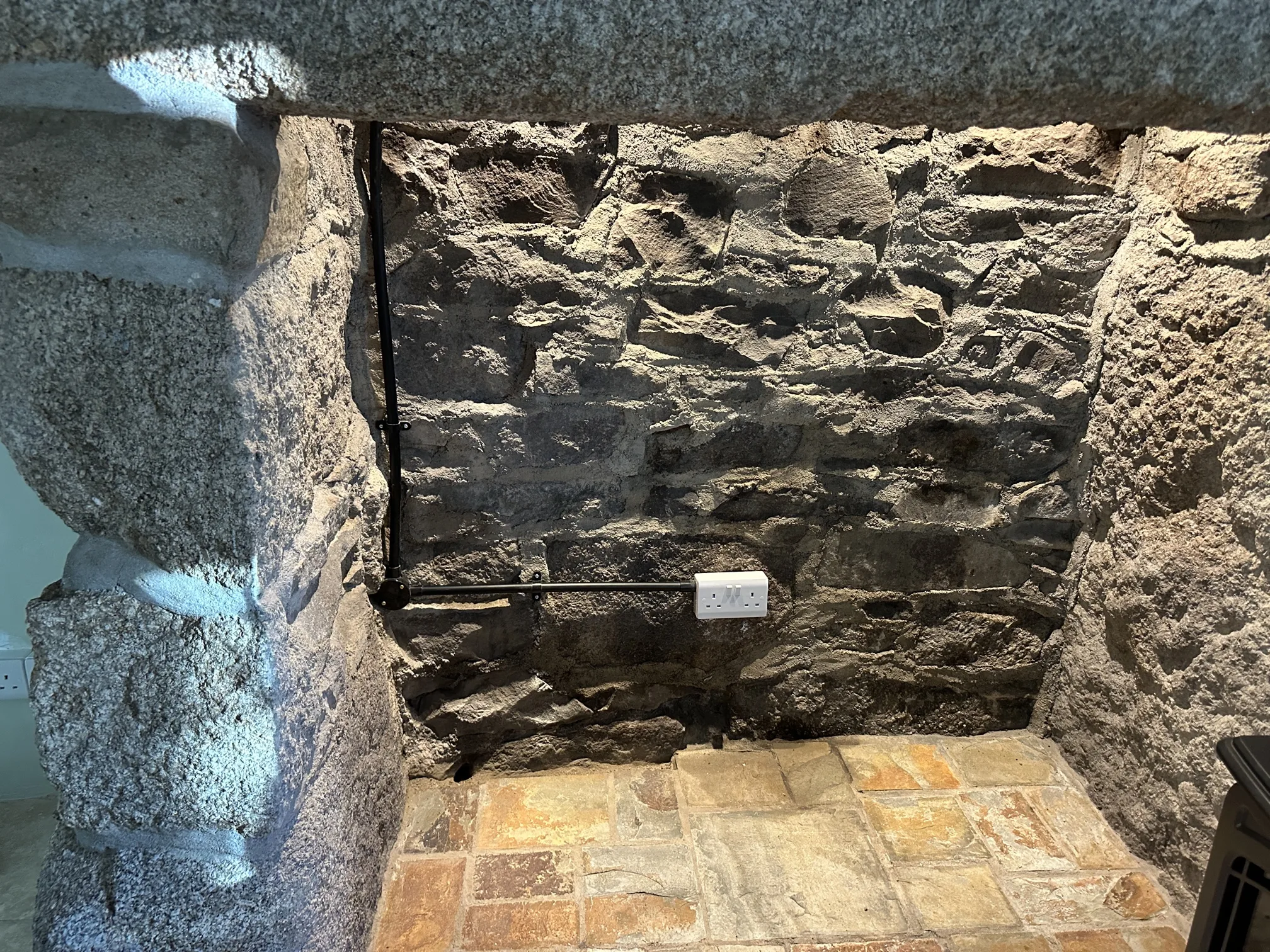
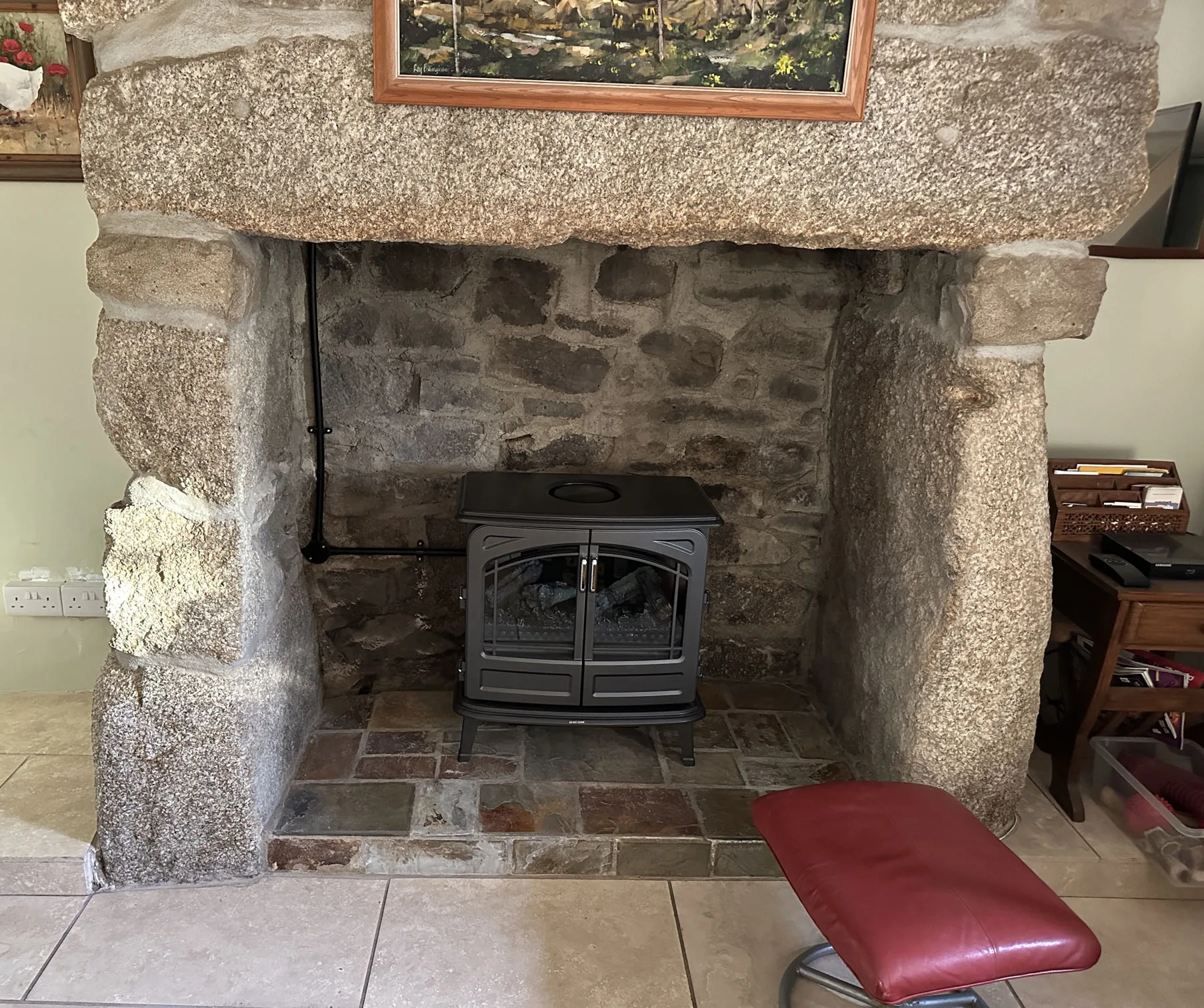
Working on a period property in Camborne, we reconfigured the electrical supply within an inglenook fireplace to accommodate an electric fire unit and atmospheric lighting, combining surface-mounted conduit work inside the chimney breast with concealed cabling throughout the rest of the room.
Period properties often present interesting challenges when homeowners want to update their heating arrangements. This particular home in Camborne featured a traditional inglenook fireplace, and the client had decided to install an electric fire unit within the chimney breast whilst adding some feature lighting to highlight the stonework. The existing electrical setup wasn’t positioned correctly for the new arrangement, which meant we needed to redesign how power was delivered to this area of the living room.
The first task involved dealing with the old socket outlet that sat adjacent to the chimney breast. This had been installed as a spur from the ring circuit, but its position outside the inglenook meant it was no use for powering the electric fire that would sit inside. Rather than leaving it in place and adding yet another socket, we decommissioned this outlet completely and extended the socket circuit to run into the chimney breast itself. The new double socket would sit behind where the fire unit would be positioned, tucked away but accessible if needed.
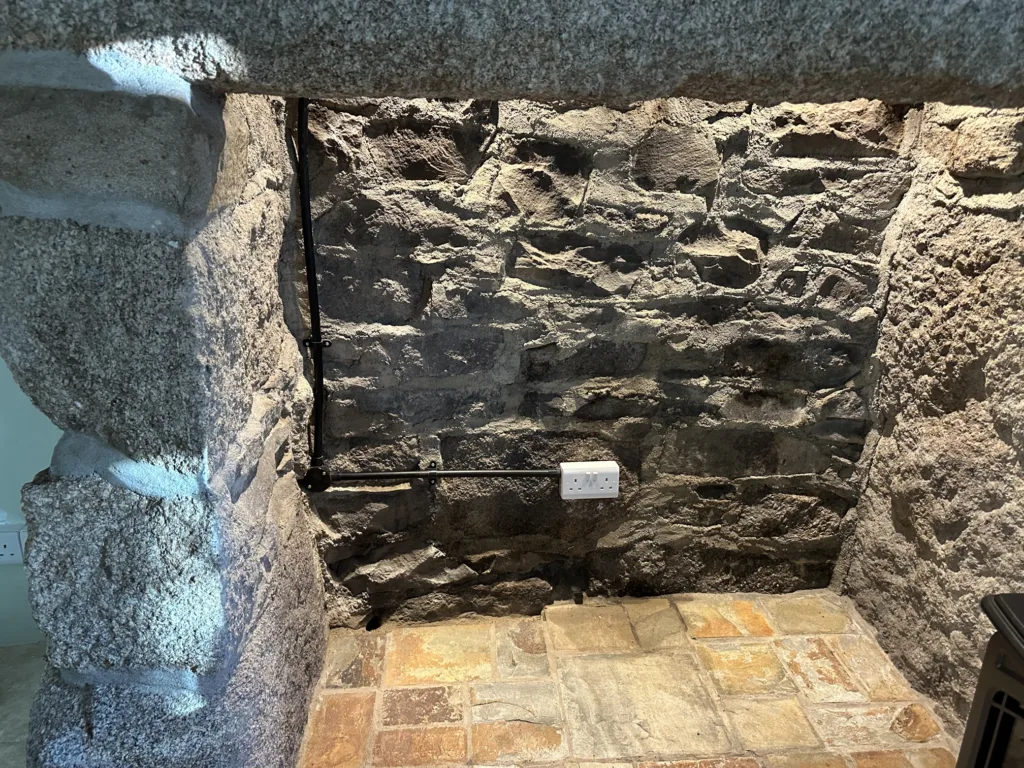
Getting cables into an inglenook isn’t always straightforward. These structures are built from solid masonry, often quite thick, and you can’t just drill through walls without thinking about what you might hit. We chased channels into the masonry outside the chimney breast to keep everything neat and concealed within the main walls of the room. Once the cables entered the chimney breast structure itself, the approach changed. Inside the inglenook, all the wiring runs in surface-mounted black PVC conduit. This keeps everything protected and maintains a clean appearance against the exposed stonework, whilst being practical for a space where concealment isn’t really an option.
The lighting aspect added another layer to the job. The client had sourced their own light fittings that they wanted installed within the chimney breast to create some ambience around the fire. We installed a fused spur to supply these lights, giving them their own dedicated circuit. The switch for controlling the lighting was positioned outside the chimney breast, next to the existing socket, so it’s easily accessible without reaching into the fireplace area. All the cabling for this lighting circuit followed the same installation method – recessed into the walls where possible, then surface-mounted in conduit within the chimney breast itself.
There’s always a balance to strike between aesthetics and practicality with this type of work. Conduit might not be everyone’s first choice visually, but in an inglenook setting where the stonework is the feature, black PVC conduit actually sits quite discretely against the textured surface. It’s also the sensible option from a maintenance perspective. If anything ever needs attention in the future, it’s far easier to work with surface-mounted systems than trying to extract cables that have been buried in century-old stone walls.
The property had another electrical change that needed addressing whilst we were there. The living room had underfloor heating that was no longer required, controlled by a fused connection unit on the wall. Rather than leaving a redundant heating system in place, we decommissioned the supply completely and replaced the fused unit with a standard double socket. This gave the homeowners another useful power point in the room whilst tidying up an electrical installation that was no longer serving any purpose.
When you’re working in older properties, you often find that previous electrical work has been done in phases, with different approaches taken at different times. This can result in a somewhat patchwork appearance where various methods and materials have been used over the years. Part of what we do involves bringing things together in a more cohesive way, using current practices whilst respecting the character of the building. The challenge with inglenook work specifically is that you’re dealing with a focal point of the room – everything you do is on show, so it needs to look intentional rather than like an afterthought.
Chasing out masonry walls and then making good afterwards requires a fair bit of care. We cut the channels for the cabling, ran the cables through, and then filled everything back in ready for the homeowner’s decorator to finish. It’s messy work, creating a lot of dust, but there’s no way around it when you need to run cables through solid walls. The alternative would be surface-mounted trunking throughout the room, which wouldn’t have suited the property at all.
The positioning of the socket inside the chimney breast needed some thought. It had to be accessible for plugging in the electric fire, but not so prominent that it became an eyesore. Behind the fire unit was the logical spot – close enough to reach if needed, but hidden from view during normal use. The same consideration went into the switch position for the lighting. It needed to be convenient to use, but positioned where it made sense in relation to the overall room layout.
Inglenook fireplaces are a feature worth preserving in older homes, and more people are finding ways to make them work with modern living rather than blocking them up or removing them entirely. Electric fires offer a practical solution – they provide heat without the maintenance and cleaning associated with real fires, whilst still giving that focal point to a room. Adding lighting into the recess brings out the texture of the stonework and creates some atmosphere in the evenings.
This type of project demonstrates how electrical work often involves more than just connecting cables together. You’re thinking about building structure, considering the visual impact of your work, planning access routes through solid walls, and coordinating different elements so everything comes together properly. The client ends up with a functional heating solution and attractive feature lighting, both powered from circuits that have been installed to meet current standards whilst working sympathetically with a period property.