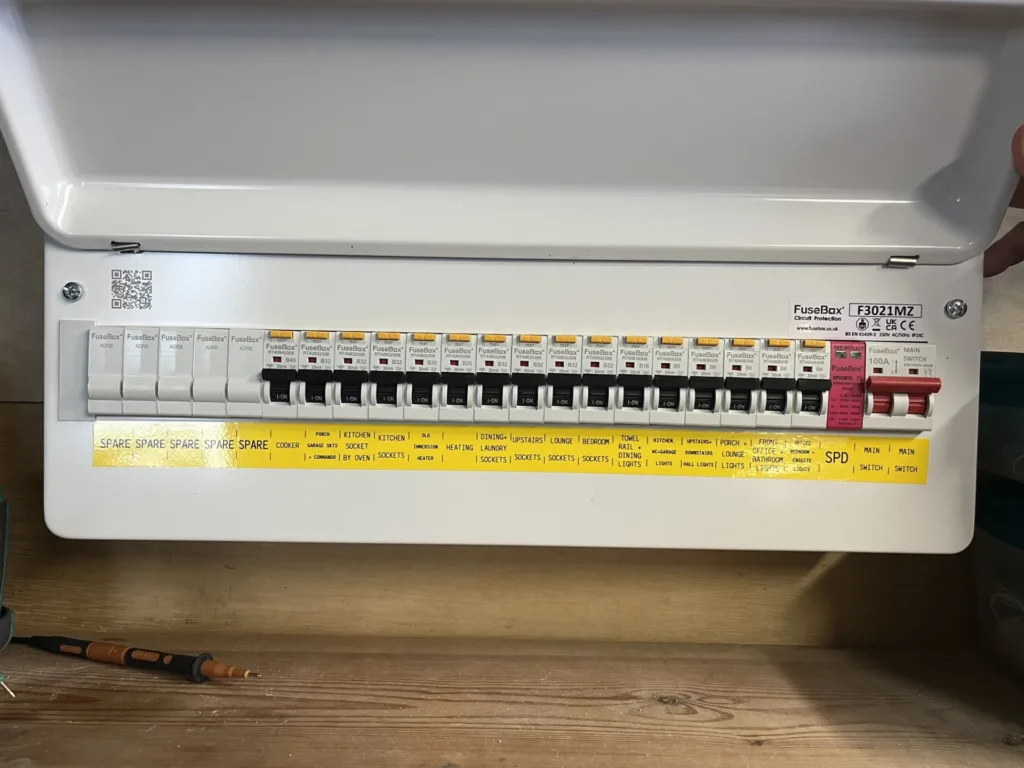
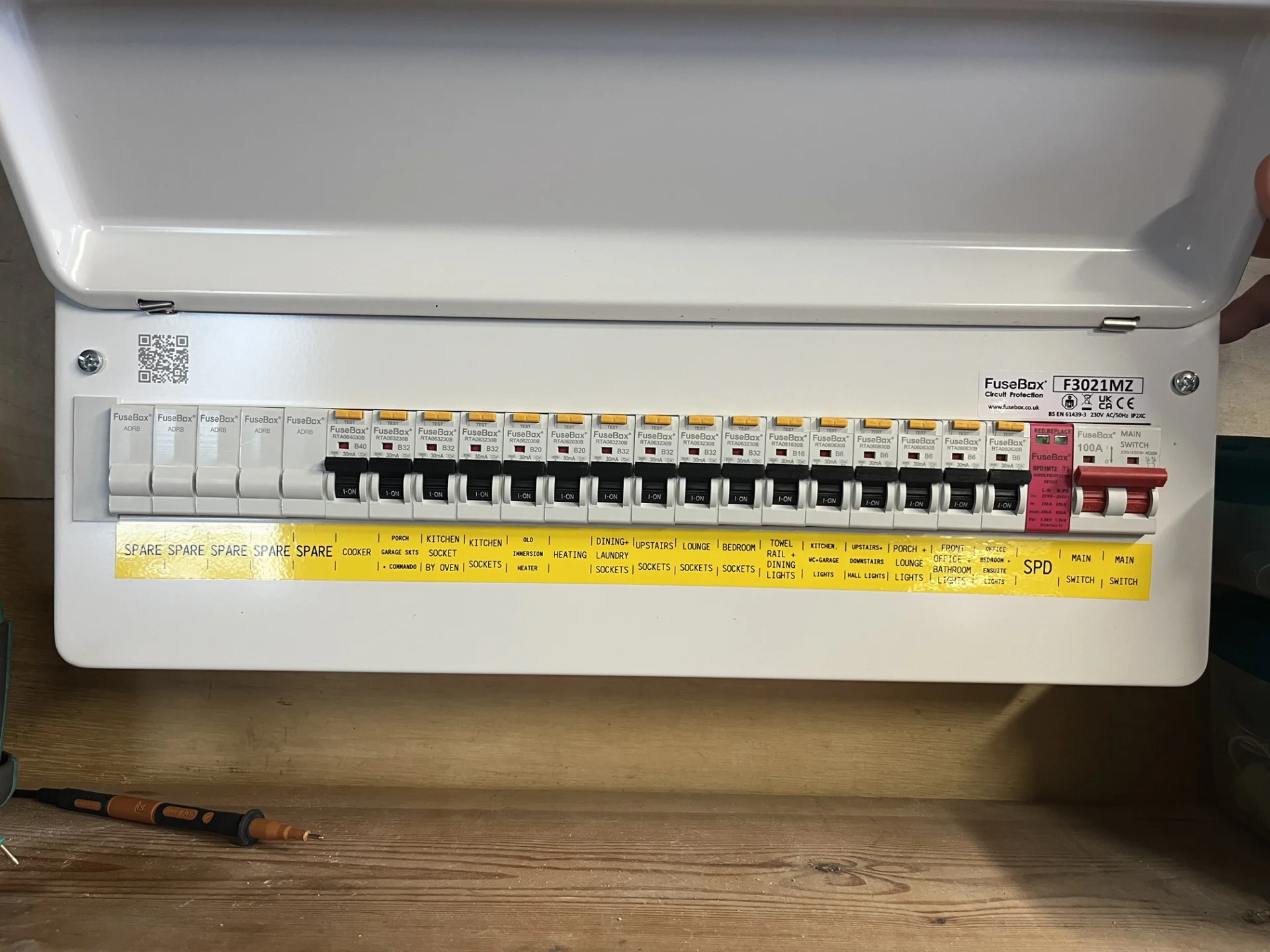
The existing consumer unit at this Newquay property had been in an awkward position for years – not at a practical height, and not up to the standard a modern installation calls for. Rather than simply lift and shift the old board, the decision was made to replace it entirely with a 21-way RCBO consumer unit complete with an integrated surge protection device, while also addressing a few other areas that needed attention while the work was being done.
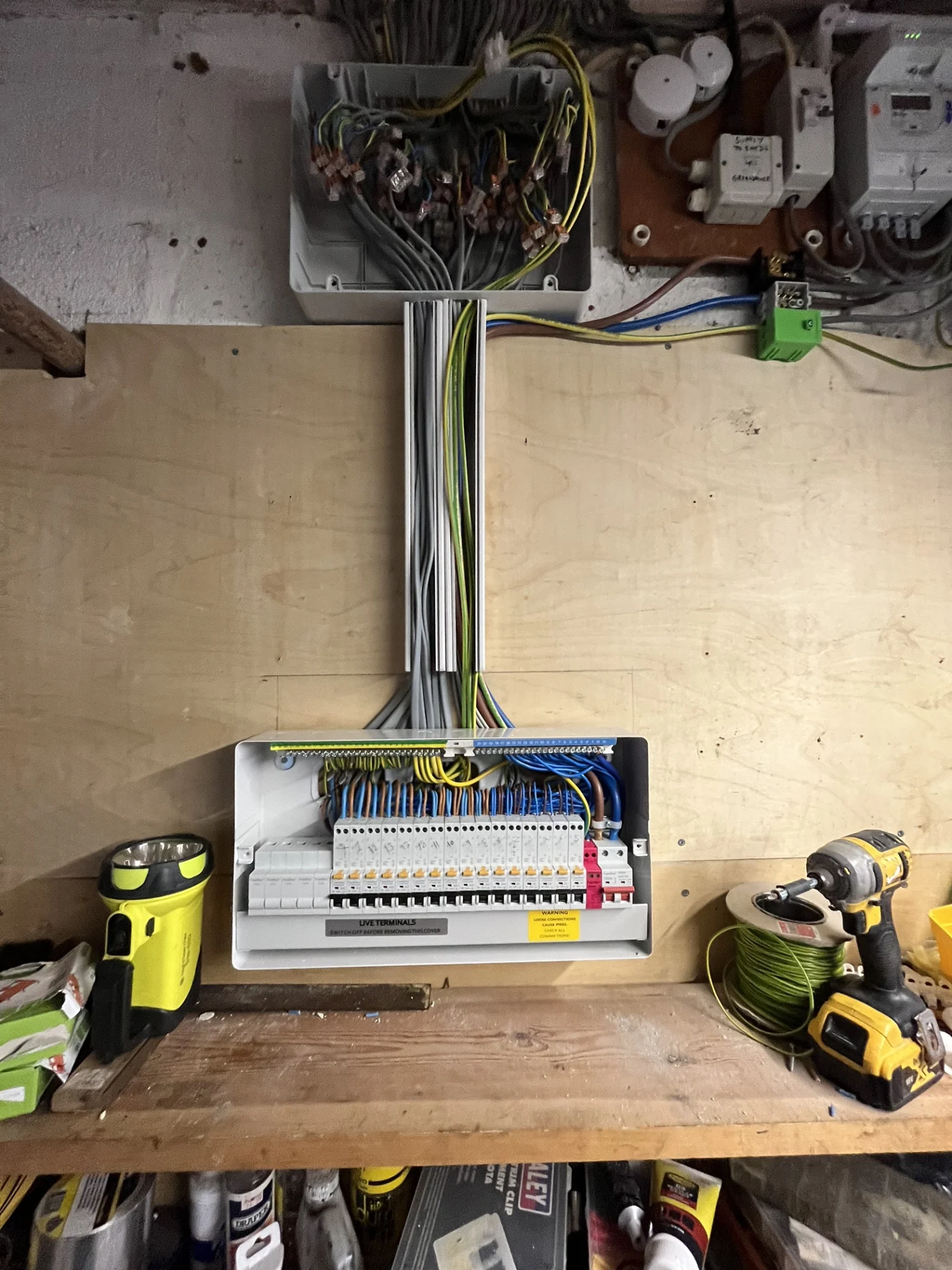
Getting the new board into the right position meant extending the existing circuits to reach it. The new consumer unit was sited directly below the original location, dropped down to a comfortable eye level. Where cables needed mechanical protection on their route down to the new unit, 50mm x 50mm trunking was fitted. It keeps the cable runs contained, protects them from any physical damage that could occur in what is a working area, and gives the whole installation a much cleaner finish than loose cables running down a wall.
The consumer unit itself is a significant upgrade on what was there before. A 21-way board provides plenty of capacity for the current circuits, plus room for anything that might be added down the line. The bigger change is in how the protection works. Each circuit is served by its own individual RCBO – a combined circuit breaker and residual current device in one unit. This matters more than it might initially seem.
Older boards typically grouped circuits behind shared RCDs, meaning a fault on one circuit could trip several others at the same time. A shared RCD protecting the upstairs ring and the immersion heater, for example, means a problem with either one takes out both. With individual RCBOs, that doesn’t happen. A fault on one circuit trips that circuit and nothing else. It’s a much more practical arrangement, particularly in a home where losing power to a freezer overnight without realising it is a real concern, or where someone working from home can’t afford to lose everything because of an unrelated fault elsewhere.
Surge protection is another area that’s become increasingly relevant as properties fill up with more sensitive electronics. The SPD built into this consumer unit is there to absorb and divert voltage spikes before they can reach connected equipment. Those spikes come from various sources – switching operations on the grid, or nearby lightning activity travelling through the supply infrastructure. The damage they cause tends to be invisible at first; a component in a television, a laptop’s power supply, or a smart appliance’s control board can be weakened over time without any immediate sign that anything’s wrong, until it fails. Fitting an SPD removes that risk. Under the 18th Edition Amendment 2 of the wiring regulations, surge protection is now a standard requirement for most domestic installations, so this wasn’t just a sensible addition – it was the correct approach for a fully compliant installation.
The incoming meter tails were also replaced as part of the project. The tails run between the electricity meter and the consumer unit and carry the full load of the property’s supply, so having them correctly rated matters. The existing tails were undersized relative to current requirements and were upgraded to 25mm double insulated cabling. A new consumer unit on its own doesn’t compensate for undersized tails upstream of it, so tackling both together means the installation is sound from the meter onwards.
Once everything was in place, a full programme of electrical testing was carried out across every circuit affected by the work. This testing produces the Electrical Installation Certificate – the formal documentation that records the installation’s condition at the point of completion. The EIC is what Building Control requires in order to register the work under Part P of the Building Regulations. That registration is what creates the paper trail that solicitors ask about when a property is sold, so it’s not a box-ticking exercise; it’s the evidence that the work was carried out correctly and to the current standard.
Consumer unit replacement in Newquay comes up for a variety of reasons. Sometimes it’s a straightforward age issue – older split-load boards reaching the end of their serviceable life. Sometimes it’s a renovation that brings electrical standards under scrutiny for the first time in years. In this case, it was a combination of a poorly positioned board and an installation that was overdue for modernisation. Repositioning the unit to eye level, fitting individual RCBOs throughout, adding surge protection, upgrading the tails, and completing the required certification means the installation is now where it should be – properly sited, fully documented, and built around current regulation.