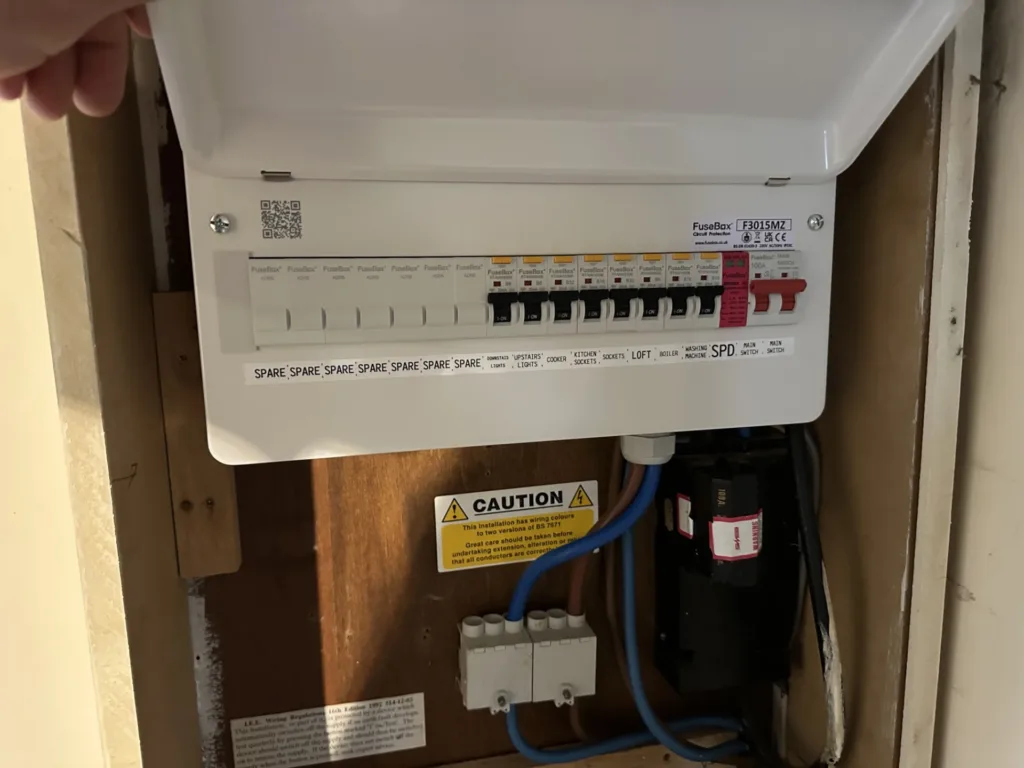
An EICR carried out at a domestic property in Bodmin came back with several observations – some relating to the consumer unit itself and one pointing to a fault on the sockets ring circuit. Rather than addressing each issue in isolation, the decision was made to complete all remedial works in a single visit: a full consumer unit replacement, investigation and rectification of the earth fault, and a satisfactory EICR issued at the end.
The existing board had reached the end of its useful life in terms of compliance. With multiple observations against it, a replacement was the most sensible path forward, and it gave the opportunity to install a unit that meets the current 18th Edition of the Wiring Regulations. The consumer unit fitted was a FuseBox 15-way RCBO board with an integrated Surge Protection Device.
RCBO protection gives each circuit its own independent combined RCD and overcurrent device. In older installations with shared RCDs, a fault on one circuit can trip the entire protective device, taking out several circuits in one go. An RCBO board avoids that – a fault on the kitchen sockets trips only the kitchen sockets, leaving everything else on. For a household with multiple occupants or anyone running sensitive equipment, this is a real practical benefit rather than just a compliance upgrade.
The integrated Surge Protection Device addresses a different kind of risk. Voltage spikes from the grid – caused by switching events, nearby lightning, or fluctuations in grid infrastructure – can reach the installation through the incoming supply. While a single surge may not cause obvious damage, repeated exposure can degrade sensitive electronics over time. Having SPD built into the consumer unit means protection is active from the point of supply, without the need for a separate device added elsewhere.
As part of the installation, the incoming meter tails were upgraded to 25mm double insulated cabling. The meter tails are the cables between the energy supplier’s meter and the consumer unit, and uprating them to 25mm double insulated is standard practice when a new board is fitted – it brings that section of the installation in line with current guidance and removes an element that could otherwise be flagged on any future inspection.
The second strand of work involved Circuit 1, the sockets ring circuit. The EICR had flagged disproportionately high R2 readings on this circuit – R2 being the measurement of the earth continuity path. Elevated readings point to a fault in the earth path, which means the circuit’s ability to safely clear a fault to earth is compromised. Day to day, this wouldn’t necessarily cause any visible problem, but it’s the kind of fault that matters precisely when something goes wrong.
Locating the fault required further testing along the ring to identify where the resistance was originating. The source turned out to be a loose earth connection within the circuit, which was re-terminated properly. Earth readings were then retested and confirmed to be within the acceptable limits set out in BS 7671.
With the consumer unit in place and the ring circuit fault resolved, full electrical testing was completed across all circuits affected by the works. This produced an Electrical Installation Certificate – a formal document confirming that the installation has been designed, constructed, inspected, and tested in accordance with BS 7671. The EIC also fulfils the Building Control Notification requirement that applies to consumer unit replacements as a notifiable electrical installation.
The final stage was updating and completing the EICR. Having carried out all the remedial works identified in the original report, the installation was re-inspected and retested to verify that each observation had been resolved. Visual inspections and electrical testing were carried out methodically across the relevant circuits, and the report was issued with a satisfactory outcome – no outstanding observations remaining.
EICR remedials are worth doing properly rather than doing the bare minimum to change a code. Replacing the consumer unit resolved several of the observations in one go, and the SPD requirement was addressed at the same time. Sorting the earth fault on the ring circuit meant the installation could be verified as genuinely satisfactory rather than just compliant on paper.
Properties where an EICR has flagged a consumer unit replacement often have older wiring to consider as well – and that’s where the testing process during a board change becomes valuable. Carrying out full circuit testing as part of the installation means any further issues can be identified rather than discovered at a later date.