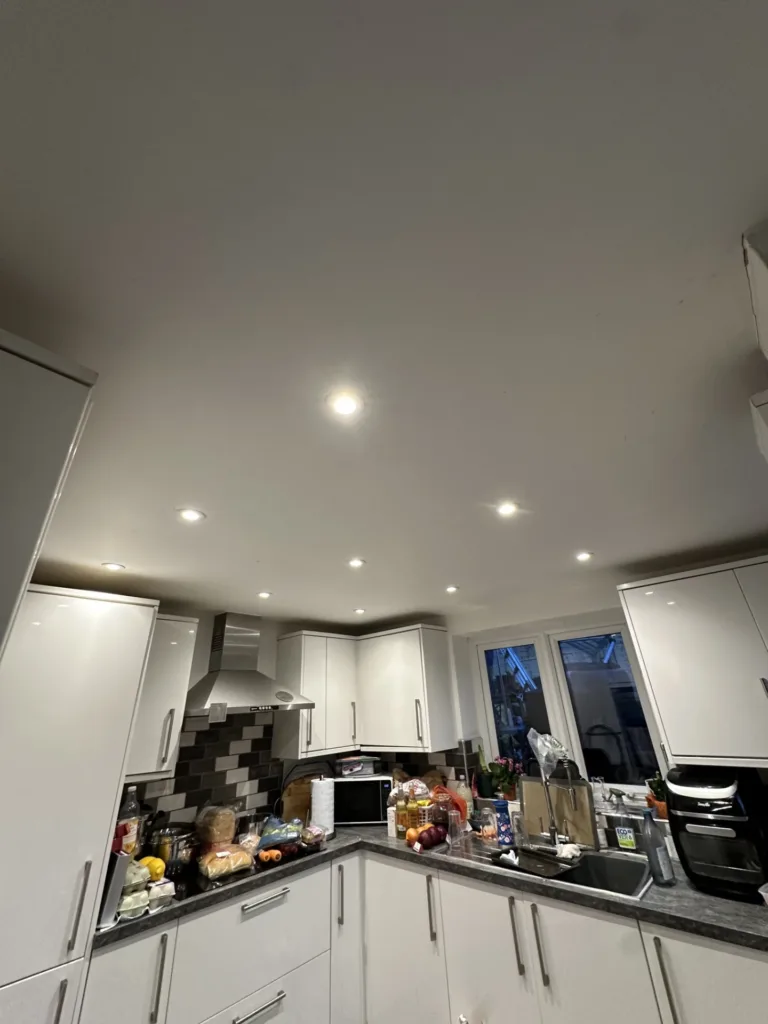
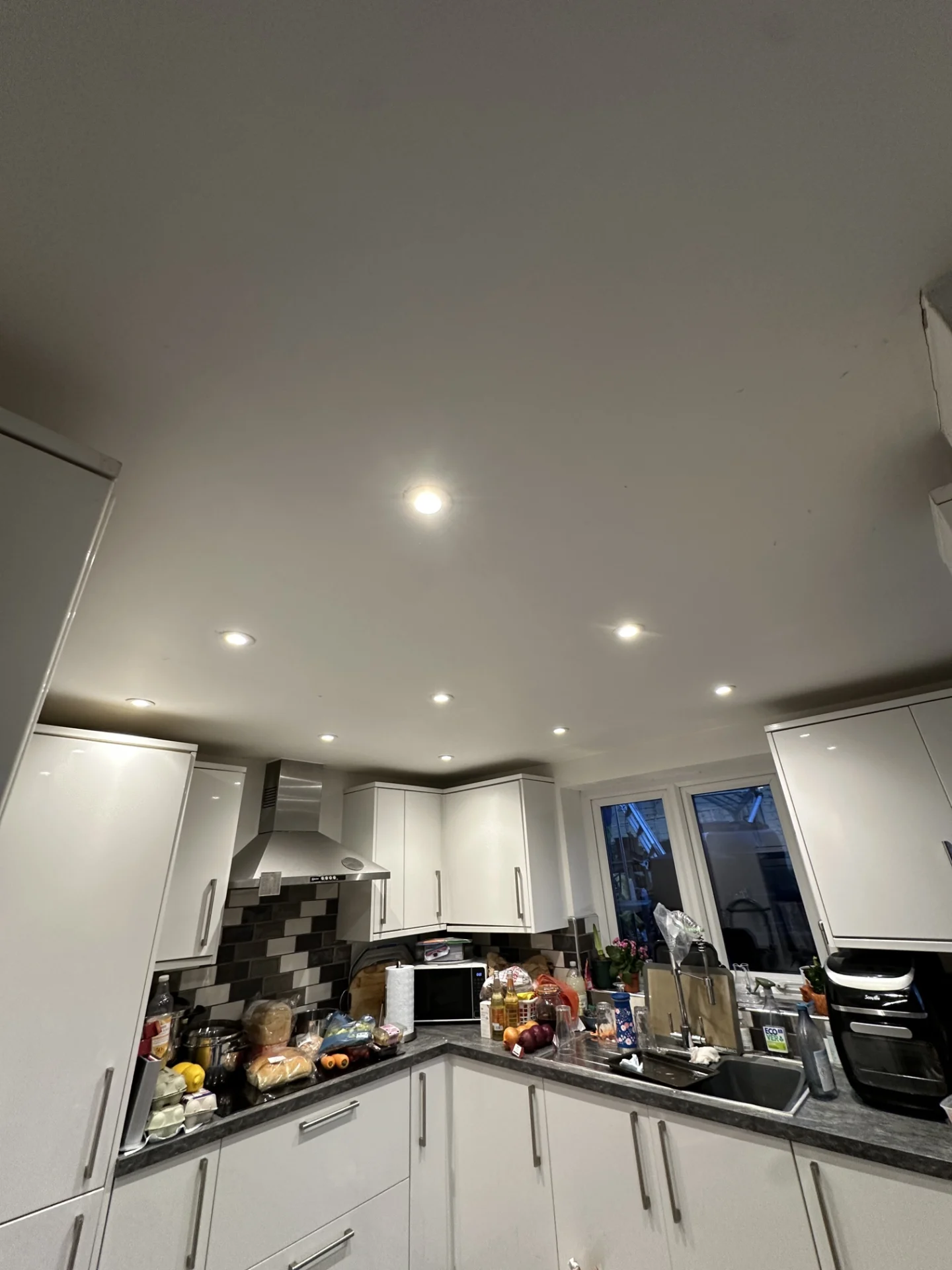
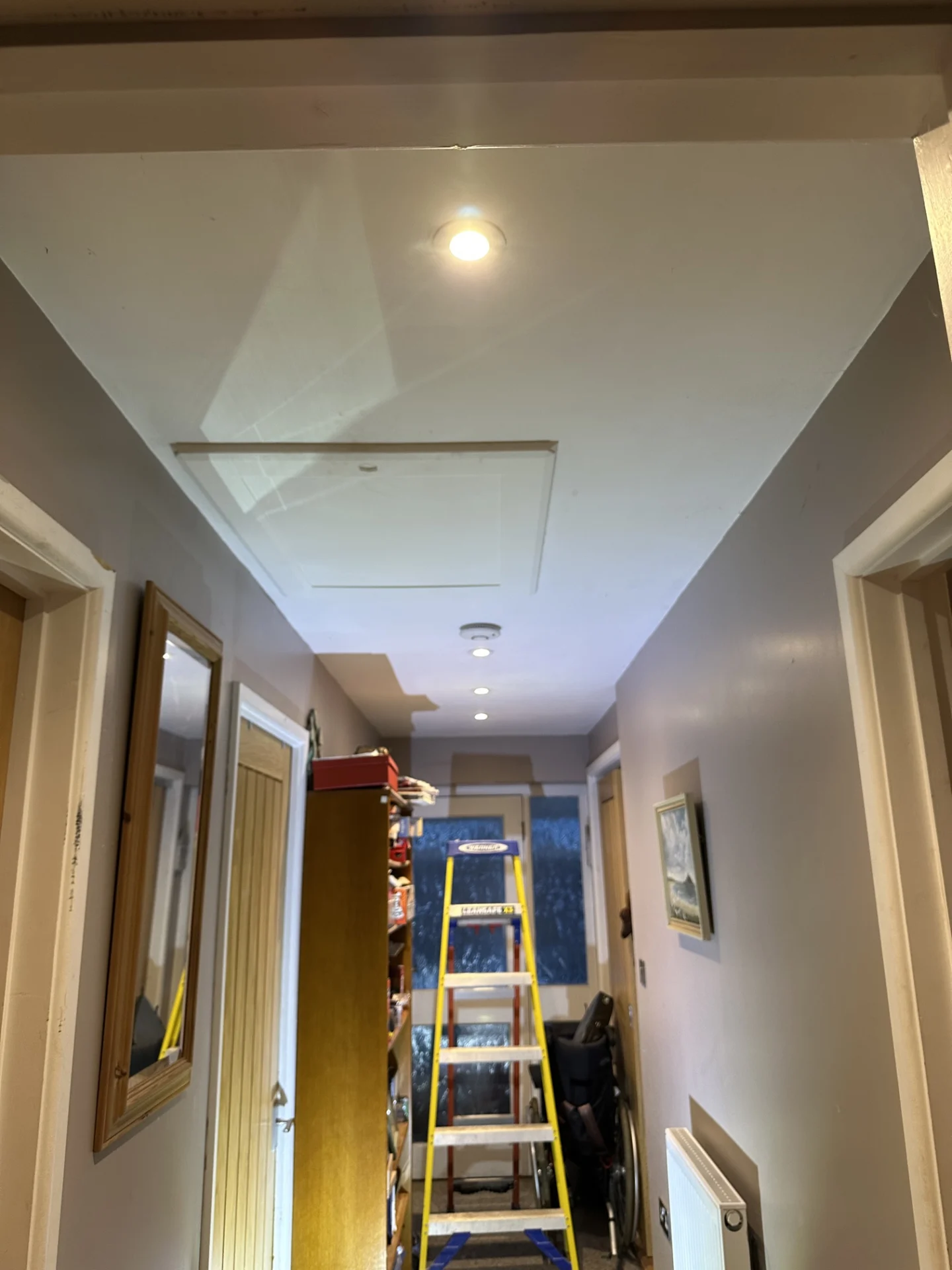
Downlights have become the default choice for domestic lighting across Cornwall over the past couple of decades, and that means a lot of older-style integrated LED fittings are now reaching the point where they’re failing or starting to cause frustration. The issue with that type of fitting is straightforward enough – when the light source gives out, the whole unit has to come out with it. There’s no simple bulb swap. For a homeowner in Penryn with 13 of these fittings spread across the kitchen and hallway, the solution was to replace the lot with fire-rated GU10 units that take a standard replaceable lamp.
The work covered two areas of the property – nine fittings in the kitchen and four along the hallway. Non-dimmable warm white lamps were specified throughout, which is a sensible choice for both spaces. Warm white, broadly in the 2700K to 3000K range, produces a softer, more settled light than the cooler daylight tones that can make a domestic kitchen feel more like a commercial space than a home. In a hallway, that same warmth makes the space feel welcoming rather than stark.
Fire-rated downlights are worth understanding a little better, because they’re sometimes treated as just another product option when they’re actually a specific requirement in a lot of domestic situations. Where a downlight is installed through a ceiling that forms a fire-separating element – for instance, where there’s a habitable room or floor above – cutting a hole through that ceiling creates a weak point in its fire resistance. Without fire-rated fittings, those holes can allow fire and smoke to travel between floors faster than the building’s construction was designed to allow. Fire-rated GU10 fittings incorporate an intumescent material that expands under heat, sealing the aperture and maintaining the ceiling’s integrity for a set period. In a standard domestic property, using them wherever there’s a floor above is the right approach.
The shift from integrated LED fittings to GU10 units also changes how maintenance works going forward. With an integrated fitting, lamp failure means calling out an electrician, sourcing a replacement unit, and fitting it – time, cost, and disruption. With a GU10 fitting, the lamp pulls straight out and a new one goes straight in. No tools, no trade visit required. For nine kitchen downlights alone, that difference adds up over the lifetime of the installation. GU10 lamps are widely stocked, relatively inexpensive, and come in a good range of colour temperatures and outputs, so there’s no difficulty finding a like-for-like replacement when the time comes.
The client sourced their own GU10 lamps for this job. With non-dimmable fittings and non-dimmable lamps, compatibility was not a concern, and the warm white bulbs were fitted into the new units once the installation was complete.
Working through 13 positions across two separate rooms is methodical work. Each existing fitting had to be isolated, removed, and the wiring assessed before the new fire-rated units could go in. Existing downlight positions don’t always make life easy – cables can sit awkwardly in the ceiling void, or the previous fittings may have been clipped or seated in ways that require care to release without marking the ceiling. Getting the replacement fittings seated level and flush, with the trims sitting cleanly against the ceiling surface, is one of those details that doesn’t get noticed when it’s right but is very obvious when it’s not.
In the kitchen, nine fittings were distributed across the ceiling to give reasonable, consistent coverage across the worktop areas and the room generally. Too few downlights in a kitchen can create uneven light with frustrating shadows over key work surfaces; nine across that space works well. The four hallway fittings were positioned to carry light along the full length of the corridor, addressing what is a common problem in long, narrow hallways where a single central pendant leaves both ends of the space noticeably darker.
This type of work comes up regularly in domestic properties across the Penryn area and the wider Falmouth and Helston area. A lot of properties that were fitted out with integrated LED downlights several years back are at the stage where those fittings are failing, and many homeowners are choosing to take the opportunity to move to something more practical rather than replacing like-for-like. Fire-rated GU10 fittings give you the same clean, unobtrusive look as the fittings they replace, they meet the relevant requirements for fire separation, and the bulbs are straightforward to source and change without any specialist knowledge.
The process itself is fairly uncomplicated for a competent electrician. In most cases, the ceiling cutout left by the old fitting will accept the new unit without modification, which avoids any need for remedial plasterwork. The old wiring is assessed, the new fitting is connected and clipped into position, and the lamp is installed once everything has been checked. Multiplied across 13 positions with two separate circuits to work through, it’s a solid half-day job, but the result is clean and the ongoing maintenance picture for the homeowner is considerably simpler than it was before.