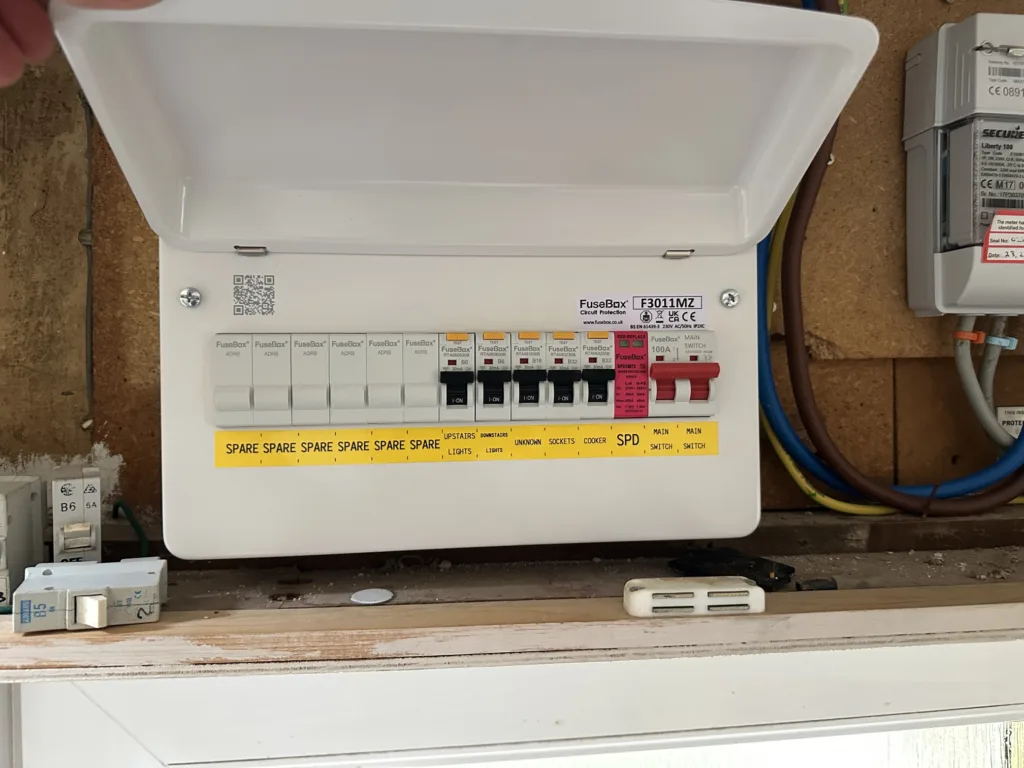
A home’s electrical system is only as safe and reliable as its weakest point, which is often an outdated consumer unit, commonly known as a fuse box. For a client in Falmouth, we undertook a significant electrical overhaul, beginning with the heart of the system. The existing consumer unit was decommissioned and carefully removed to make way for a modern, fire-rated 11-way replacement. This new unit adheres to the latest 18th Edition of the IET Wiring Regulations (BS 7671) and offers substantial improvements in safety and convenience. Each circuit is now protected by an individual RCBO (Residual Current Breaker with Overload protection). Unlike older systems where a single fault could plunge the entire house into darkness, RCBOs isolate the fault to the specific circuit. This means if a kitchen appliance develops a fault, the lights and sockets in the rest of the house remain fully operational, minimising disruption and making it much easier to identify the source of the problem.
A critical component of this new consumer unit is the integrated Surge Protection Device (SPD). In an age where homes are filled with microchip-controlled electronics – from smart TVs and games consoles to washing machines and computers – the risk posed by voltage surges is greater than ever. These surges, often caused by events on the national grid or nearby lightning strikes, can inflict instant and irreparable damage on sensitive equipment. An SPD acts as a crucial line of defence, detecting and diverting these excess voltages safely to earth before they can harm connected devices. To properly support the new unit and the home’s electrical load, we also upgraded the incoming meter tails. The old wiring was replaced with new 25mm double-insulated cabling, the current standard for ensuring the main supply cables can handle the power demands of a modern household safely and without overheating.
With the core electrical system upgraded, attention turned to the living room. The client’s goal was to create a clean, contemporary media and feature wall centred on the chimney breast, but the existing socket layout was not suitable. To achieve this, we extended the living room’s ring circuit to provide power in two new locations on the chimney breast. One double socket was installed at a mid-height level, positioned perfectly to power a wall-mounted television and associated media devices, eliminating the common issue of unsightly cables trailing down the wall. A second double socket was fitted at a lower level, providing a dedicated and convenient supply for a new electric fireplace unit.
Executing this required all new wiring to be completely concealed for a flawless finish. Our process involved chasing channels into the wall of the chimney breast to recess the new cabling and back boxes. To run the cables from the existing circuit to this new location, we gained access to the floor void of the bedroom directly above. This involved carefully lifting the carpet and floorboards to route the wiring discreetly and safely between the floor joists. This method avoids any surface-mounted trunking, preserving the room’s aesthetic. Once the new sockets were wired and tested, the chased sections of the wall were filled with bonding plaster, leaving a smooth surface ready for the client to arrange their final decoration. As part of these living room alterations, we also lowered another existing socket in the room, re-routing its cabling behind the timber panelling to remove the last piece of visible surface wiring.
The final task was to address a serious safety concern in the kitchen. A section of the kitchen socket circuit’s cabling, hidden away beneath the sink unit, had been gnawed by rodents. Damaged cable insulation exposes live conductors, creating a severe risk of electric shock and fire. The repair involved isolating the circuit, carefully cutting away the compromised section of cable, and reinstating it with a new piece of wiring. All connections were made using regulation-compliant methods to ensure a robust and safe repair, fully restoring the integrity of the circuit. The client was also informed about the potential for further hidden damage elsewhere on the circuit, a sensible precaution following any discovery of rodent activity. Following completion, all circuits were thoroughly tested and certified, leaving the Falmouth home with a much safer, more functional, and future-proof electrical installation.