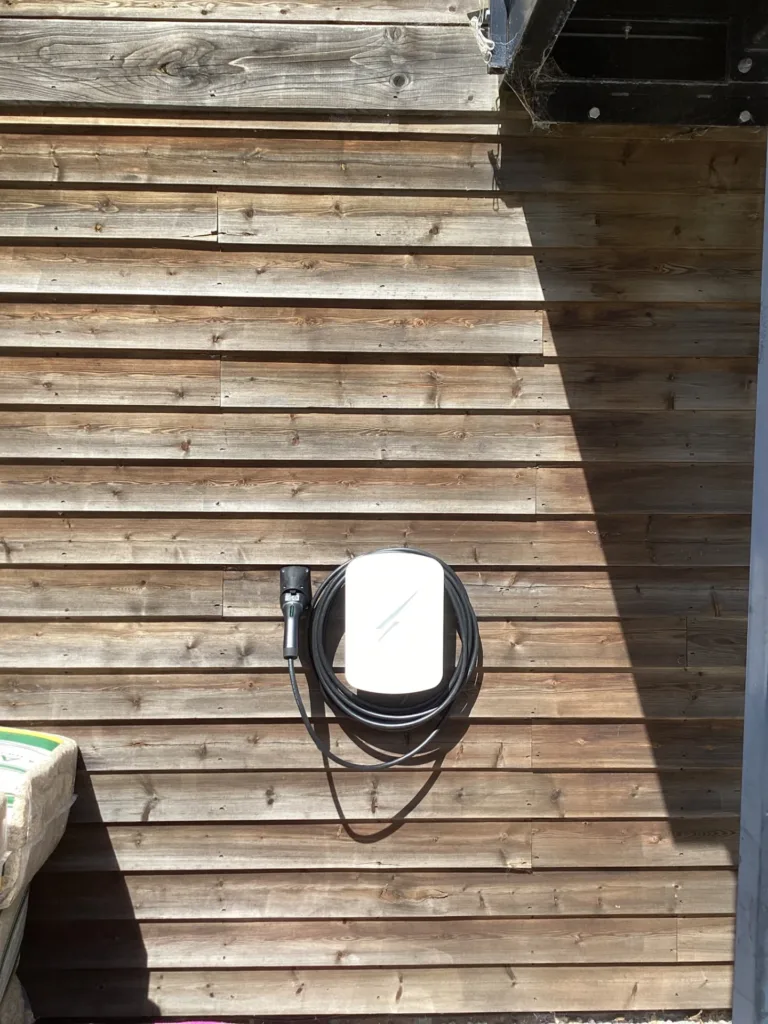
Getting an EV charger fitted when your property has an outbuilding or detached garage does throw up a few more considerations than a straightforward house wall installation. This job in Tavistock was a good example of that – the supply to the garage was already in place, but there were some things to work through before a 7.4kW charger could be added to the circuit safely and compliantly.
The charge point itself is a white Hypervolt tethered unit with a 10-metre charging cable. Tethered means the cable is permanently fixed to the charger rather than removable – the driver just picks up the cable and plugs in, with no need to carry a separate lead around. It also means there’s nothing to walk off with, which is worth considering if the charger is in a location that’s accessible to others. The unit was mounted on the exterior wall of the garage, directly on the opposite side to where the internal distribution board sits, which kept the circuit run as short and direct as possible.
The electrical supply to the charger feeds from the existing consumer unit within the garage, which itself is supplied from the main house via the existing outbuilding circuit. That garage consumer unit is a Hager 17th Edition split-load board, and it happened to have one spare way available – which meant a new circuit breaker could be installed there to feed the charge point without needing additional board work on that unit. That said, the existing RCD within the board did need swapping out. The original RCD was replaced with a Type A unit, which is the correct type for EV charging circuits. Standard Type AC RCDs aren’t suitable where the charging equipment can produce DC fault currents, so this is a straightforward but necessary part of the job.
Over at the main house, the existing RCBO feeding the garage circuit was upgraded to a 40A unit. The reason for this comes down to the overall load the circuit would now be carrying. With the EV charger drawing up to 7.4kW and other garage loads potentially running at the same time, the original RCBO rating was no longer adequate and would likely cause nuisance tripping. Upgrading it reduces that risk during normal use, though it’s worth being transparent here – when you’re adding a significant load like a 7.4kW charger to an existing outbuilding circuit that’s also serving other purposes, you’re working close to the circuit’s operational limits. Occasional tripping during periods of very high simultaneous load isn’t something that can be entirely ruled out, and any quote or job discussion should reflect that honestly.
One of the more considered elements of this installation was the load monitoring setup. A CT clamp was installed to monitor the electrical load on the property, which allows the Hypervolt’s smart system to reduce or pause charging if the overall demand gets close to the supply limit. The way this was achieved here was straightforward – the existing data cable already in place for the property’s solar system had spare cores running through it. Rather than running a whole new data cable from the house to the garage, those spare cores were used to connect the CT clamp back to the charger. It’s the kind of detail that keeps the finished install tidy and avoids unnecessary extra cabling.
The wiring from the garage distribution board out to the charge point was contained within trunking run down the interior wall of the garage and through to the rear of the unit on the outside. Trunking keeps everything orderly and protects the wiring from any potential damage in a working garage environment.
Once the physical installation was complete, electrical testing was carried out on the new circuit to produce the Electrical Installation Certificate. This is a requirement for any new circuit and is also what triggers the Building Control Notification – the formal process by which the work is notified to the local authority as compliant with Part P of the Building Regulations. The certificate covers the testing results for the circuit, confirming it’s been installed and tested to the relevant standards.
The Hypervolt was then paired and commissioned through its smart system, with everything confirmed as operational before leaving site. The smart commissioning process sets up the load monitoring, connects the unit to the home network, and allows the owner to control charging through the Hypervolt app – scheduling charges, monitoring energy use, and taking advantage of off-peak tariffs if they’re on an EV-friendly energy plan.
For anyone in Tavistock or the surrounding area with a detached garage or outbuilding and thinking about EV charging, this sort of installation is very much achievable – it just needs a proper survey of the existing electrical setup first. The condition and rating of the existing consumer unit, available spare ways, and what else is running on the circuit all feed into what work is needed. Getting that scoped out properly before any work starts means no surprises and a compliant, safe result.