The growing number of electric vehicles on Cornish roads has made home charging an increasingly practical consideration. For holiday let owners in particular, guests travelling long distances to reach a coastal destination often want somewhere to charge their car overnight – and a dedicated charge point on the property makes that possible in a way that a standard domestic socket simply can’t match.
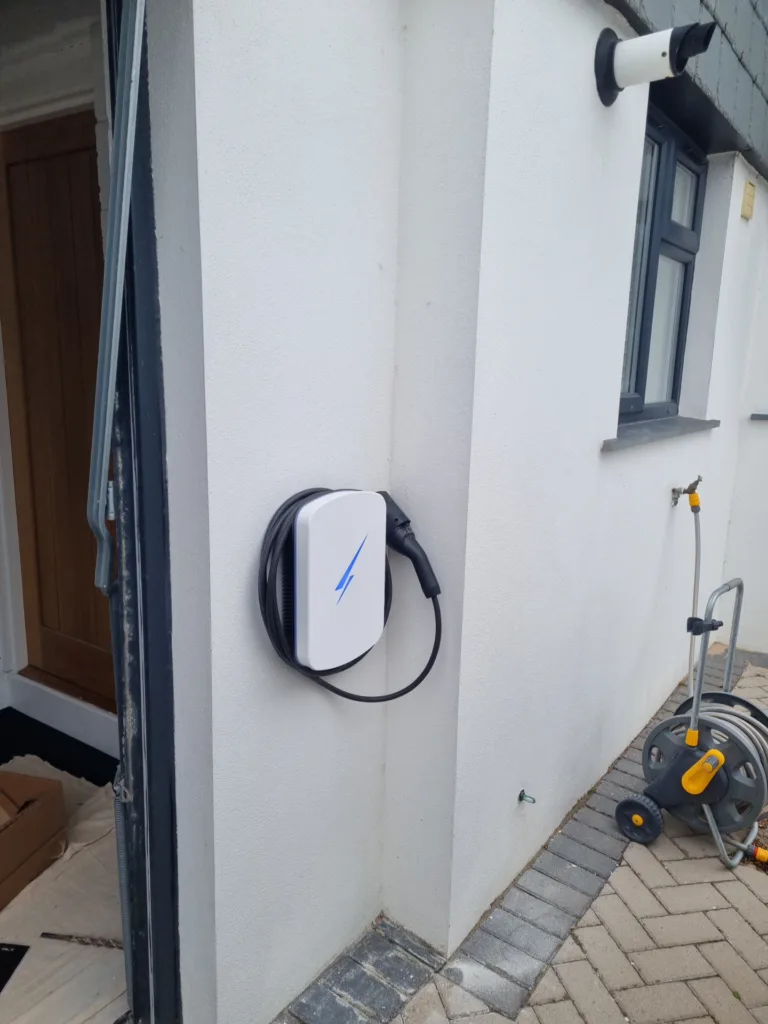
This installation centred on a Hypervolt 7.4kW tethered unit, finished in white, with a 5m charging cable. The charger was positioned on the exterior wall of the property, mounted on the side pier of the garage close to the existing consumer unit. Placing it there keeps the circuit run short, avoids unnecessary cable length, and means the charger is accessible from the driveway without needing the garage to be open.
On the charging output – 7.4kW is the standard rate for a single-phase home charge point. At that output, most electric vehicles can recover a significant range overnight from a fairly low state of charge, which is about as much as the majority of users would ever need from a domestic charger. It’s noticeably faster than charging from a conventional socket, and for holiday guests arriving after a long drive, having the car ready to go the following morning without any fuss is exactly the point.
The “tethered” part is worth understanding. A tethered charger has a fixed cable permanently attached to the unit itself, rather than relying on a separate lead that the driver brings with them. For a personal vehicle at home, it’s mainly a convenience thing. For a holiday let, it matters a bit more than that. Guests arrive without necessarily knowing what cable they need, and a tethered installation removes that question entirely – they plug in and charge, no extra equipment required. Because the cable is fixed to the unit rather than being a removable accessory, there’s nothing to go missing between stays or get left behind by a departing guest.
A dedicated 40A circuit was installed to supply the charger, with a new 40A MCB added to the existing consumer unit. As part of that board work, the existing RCD was replaced with a Type A unit. The reason for this is straightforward – Type A RCDs detect a wider range of fault current types than a standard Type AC device, including the smooth DC fault currents that can occur with EV charging equipment. A Type AC RCD may not respond to that kind of fault, which is why a Type A unit is required for charger installations rather than simply adding the charger to an existing circuit without addressing the protection at the board.
A load monitoring device was installed alongside the charger. This continuously watches the total electrical demand on the property’s supply and automatically limits the charger’s output if the property as a whole is drawing close to its capacity. The car continues to charge throughout – it just does so at a reduced rate during those periods rather than competing with everything else running in the property at the same time. It’s a background function that most users wouldn’t be aware of day-to-day, but it’s an important protection against pushing the supply beyond its limits. For a holiday let where guest usage patterns are unpredictable, that kind of automatic management is worth having built into the setup from the start.
With the charger in place and the system commissioned, the circuit was fully tested. An Electrical Installation Certificate was produced from those test results, documenting the circuit and confirming it was installed and performing correctly. The certificate also feeds into the Building Control Notification process, formally recording that the electrical work has been carried out in line with the relevant regulations. For a new EV charger installation, these steps are part of the process rather than optional additions.
The Hypervolt is designed around a companion app, which gives the property owner visibility of charging sessions and the ability to manage charging remotely where needed. On-site commissioning confirmed the system was fully paired and operational before handover.