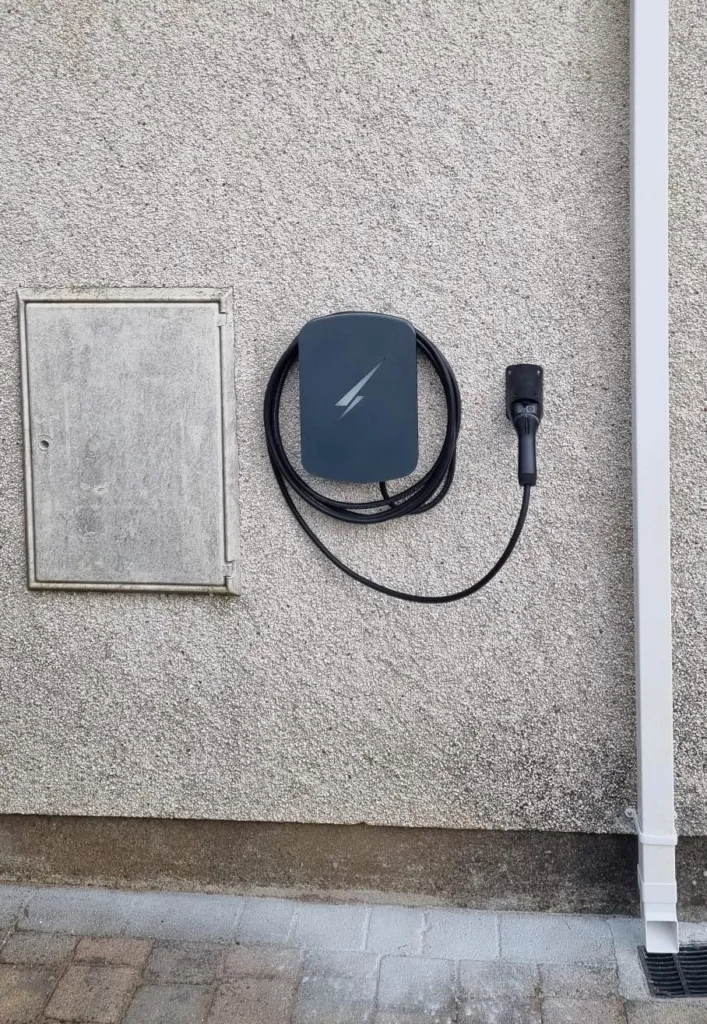
EV charger installations have become a regular part of what we do, but that doesn’t mean every job is the same. This one in Cubert involved a Hypervolt Home 3 Pro installation alongside a full consumer unit replacement – and when you combine the two, there’s a fair bit to think through before anything goes on the wall.
The property already had Solar PV in place, which changed the scope of the EV charging setup quite a bit. Simply wiring in a charger and calling it done wasn’t going to cut it – the electrical infrastructure needed to be looked at as a whole. That meant planning a proper integration between the charge point, the existing solar generation, and the rest of the property’s electrical supply.
The Hypervolt Home 3 Pro (Space Grey) was the unit of choice here. It’s a 7.4kW tethered charger, meaning the cable is fixed to the unit itself rather than being something the homeowner needs to plug in separately. At 7.5 metres, the cable gives plenty of reach, and the charger was mounted on the exterior wall at the side of the garage – a practical spot that keeps it protected while remaining accessible.
A 40A bi-directional circuit breaker handles the electrical supply to the charge point. The bi-directional element is worth noting – it’s not just about getting power to the charger, but about how the charge point interacts with the wider electrical system, particularly where Solar PV is involved. A load monitoring device was also installed as part of the setup. This continuously reads the total electrical demand on the property and feeds that information back to the charge point, which can then reduce its draw if the property’s overall load starts getting towards the limit. It’s a sensible safeguard that avoids the risk of overloading the supply.
The Solar PV side of things was tied in through an additional energy monitoring clamp. This allows the Hypervolt to see how much generation is coming from the panels at any given time, which can be used to optimise charging – drawing more power when the sun is producing well, for example. Once the hardware was in place, the system was fully commissioned and tested to confirm it was all working correctly together.
Running alongside all of this was a full consumer unit replacement. The existing setup was consolidated into a new 21-way fire-rated RCBO consumer unit with an integrated Surge Protection Device. Every circuit – both old and the new EV circuit – was brought into the new board, giving the property a clean, properly protected distribution setup going forward.
The incoming meter tails were upgraded to 25mm double-insulated cabling at the same time. This is something that often gets overlooked on older installations, but with the additional load that an EV charger introduces, having the right cable size at the incoming supply is part of doing the job properly rather than just the minimum required.
The consumer unit installation was carried out in line with the 18th Edition of the Wiring Regulations, with full electrical testing of all circuits once the work was complete. An Electrical Installation Certificate was produced, and the work was notified to Building Control as required.
The SPD built into the consumer unit provides protection against voltage spikes from the grid – something that’s genuinely useful for any property running sensitive electronics, and particularly relevant where smart systems like an EV charger and Solar PV inverter are in play.
From the outside, the finished result is a tidy-looking Space Grey Hypervolt sitting on the garage wall. Behind that, there’s a properly upgraded electrical system that’s been designed to handle the demand of home EV charging while keeping everything working safely alongside the solar generation already on the property.