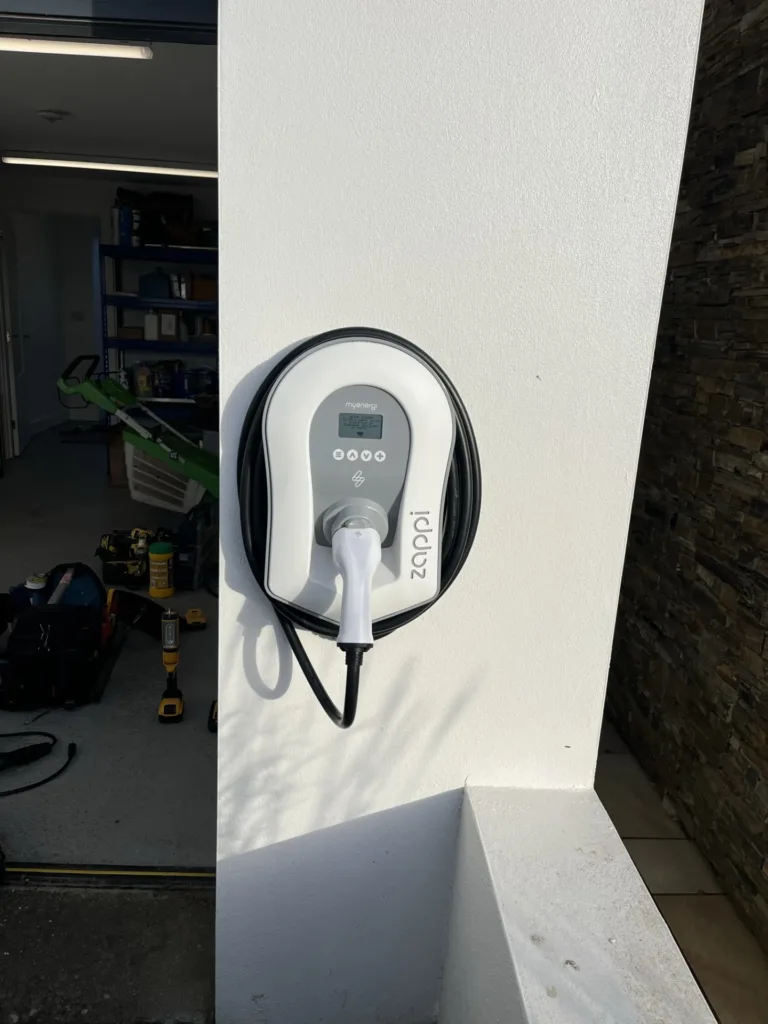
Home charging for electric vehicles is one of those things that sounds straightforward until you start thinking about how it needs to work alongside everything else in the property. This installation in Cornwall was a good example of getting the detail right – a MyEnergi Zappi fitted at a property that already had solar panels, with the two systems set up to work together properly rather than just sitting alongside each other independently.
The Zappi is a 7.4kW tethered charger, mounted on the exterior wall at the front of the garage. Tethered means the cable is fixed to the unit rather than stored separately, so there’s no need to keep a type 2 cable to hand – you just walk out and plug in. Where this charger earns its keep over a standard charge point is in how it handles solar generation. When the panels are producing more than the property is consuming, the Zappi can divert that surplus into the vehicle rather than letting it export back to the grid. For a household that already has solar, that’s a meaningful difference in how much of that generated electricity actually gets used on site.
Supplying the charge point properly meant installing a dedicated consumer unit adjacent to the meter cupboard at the rear of the property. This includes a 40A bi-directional circuit breaker and an integrated surge protection device, which guards connected equipment against voltage spikes from the grid – worth having when smart charging electronics are involved. The incoming meter tails were split using 100A connectors to feed the new EV consumer unit alongside the existing supply, with no disruption to the rest of the installation. Everything was carried out in accordance with 18th Edition wiring regulations.
Load monitoring was also installed as part of this project. The device watches the property’s overall electrical draw and reduces the charging rate if the house is already pulling a heavy load – washing machine, tumble dryer and so on running at the same time. It removes the risk of overloading the supply and means the charging adjusts automatically without any input from the homeowner.
The cable route from the new consumer unit to the charge point was planned to keep things as tidy as possible. The supply cable runs clipped at low level beneath the render bell-cast along the rear of the property, enters the garage from the rear, passes through existing boxing via the WC, and then runs surface-clipped at low level through the garage to reach the Zappi on the front wall. Where existing routes and boxing were available, they were used rather than chasing new channels unnecessarily.
Alongside the EV installation, the existing solar system was given a full service and test. This covered a visual inspection of the whole system, cleaning the panels to remove accumulated dirt and debris, and testing both the AC and DC sides to confirm the system is performing as it should. Solar panels are fairly low maintenance, but dirt build-up does reduce output over time, and a system that’s also feeding a Zappi is doing a harder job than one that’s only supplying the household or exporting to the grid.
An Electrical Installation Certificate was issued for the installed circuits, and the relevant building control notifications were submitted to cover the works. The Zappi was fully commissioned and paired on the day before the job was signed off.