Positive Input Ventilation Installation – St Austell
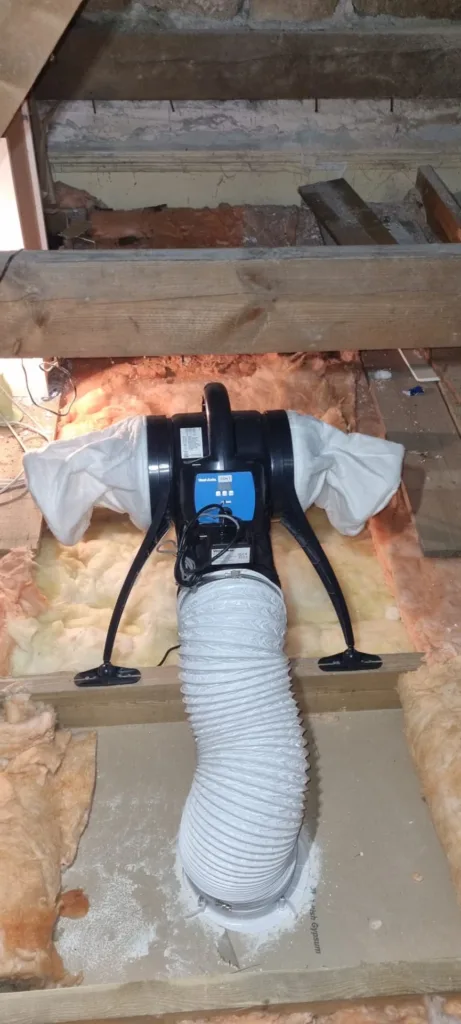
A Nuaire Drimaster PIV unit was installed at a residential property in St Austell, with the ceiling outlet positioned centrally on the landing to allow air distribution across the whole property. Power was drawn from an existing lighting circuit, and an isolator was fitted in the loft space. Seven pendant lights were also replaced as part of the same visit.
July 2026
Extractor Fans & PIV Fans, St Austell
Condensation is one of those problems that creeps up gradually. Surface moisture on windows, a faint smell in a bedroom, the early signs of mould around a window reveal – it can take a while before a homeowner realises they’ve got a ventilation issue rather than just a cold wall. At this St Austell property, the solution was a Nuaire Drimaster PIV unit, installed in the loft space with the outlet centrally positioned on the landing ceiling.
Positive input ventilation works on a straightforward principle. The unit draws air from the loft space, filters it and delivers it into the home via a single ceiling outlet. Because air is continuously being introduced, the property maintains a gentle positive pressure internally, which means stale, moisture-laden air is gradually pushed out through the natural gaps and ventilation points that exist in any building. It’s a whole-house approach rather than targeting a specific room, which is why the outlet location matters – positioned centrally on a landing or hallway, the fresh air can reach bedrooms, bathrooms and living spaces without needing multiple units or ductwork runs.
The Nuaire Drimaster specified for this installation includes an integrated 400W heater. Without a heater, air drawn from a cold loft in winter would arrive into the living space at a low temperature, which is uncomfortable and can actually worsen condensation near the outlet. The heater brings the supply air up to an appropriate temperature before it enters the property, so the system works properly year-round. The heater function operates automatically based on loft conditions rather than needing manual adjustment.
Rather than running a new dedicated circuit for the unit, power was taken from an existing lighting circuit in the property. This is a common approach for PIV installations where the lighting circuit has sufficient capacity, and it keeps the wiring neat without the disruption of a new cable route back to the consumer unit. An isolator was fitted in the loft space alongside the unit, giving a safe and convenient means of isolating the PIV independently without cutting power to the lights.
The outlet itself was positioned centrally on the landing ceiling. Getting that position right is worth some thought – too close to a bedroom doorway and the airflow can feel draughty; tucked against a wall and the distribution across the floor plan becomes uneven. A central landing position allows air to move naturally into the rooms branching off it, which is the approach Nuaire recommends for the Drimaster and the reason landing installations are so common for this type of unit.
Alongside the PIV work, seven pendant light fittings were replaced across the property. The client had sourced the fittings themselves, so this was a case of removing the existing pendants and fitting the new ones – practical work that was carried out at the same time to avoid a second visit.
PIV systems tend to be misunderstood. They’re sometimes compared to extractor fans, but the two do very different things. An extractor fan removes air from a single wet room – a bathroom or kitchen – at the point where moisture is being generated. A PIV system works on the whole property by changing the overall balance of air movement, which addresses condensation that forms in areas away from the obvious moisture sources: the bedroom where occupants are sleeping, the corner of a living room, the inside of a built-in wardrobe. These are the spots where condensation becomes a long-term problem and where a room-by-room extraction approach doesn’t reach.
The Nuaire Drimaster range is one of the more established products in the UK PIV market and has been widely installed in domestic properties for a number of years. The version used here – with the integrated heater – is suitable for properties where loft temperatures drop significantly in winter and where tempering the incoming air is necessary for the system to function comfortably.
Installation of the isolator in the loft space is a practical requirement for this kind of unit. Access to the loft is straightforward in most properties, and having the isolator there rather than hidden behind the ceiling outlet means the unit can be safely switched off for any future servicing or maintenance without affecting the circuits it shares a supply with.
For properties where condensation has been a persistent issue, PIV offers a low-maintenance route to improving internal air quality. There are no filters to clean in wet rooms, no grilles to keep clear, and the unit operates quietly in the background without any intervention needed from the occupants on a day-to-day basis. The loft-mounted installation keeps the unit itself out of sight, with only the ceiling outlet visible inside the property.