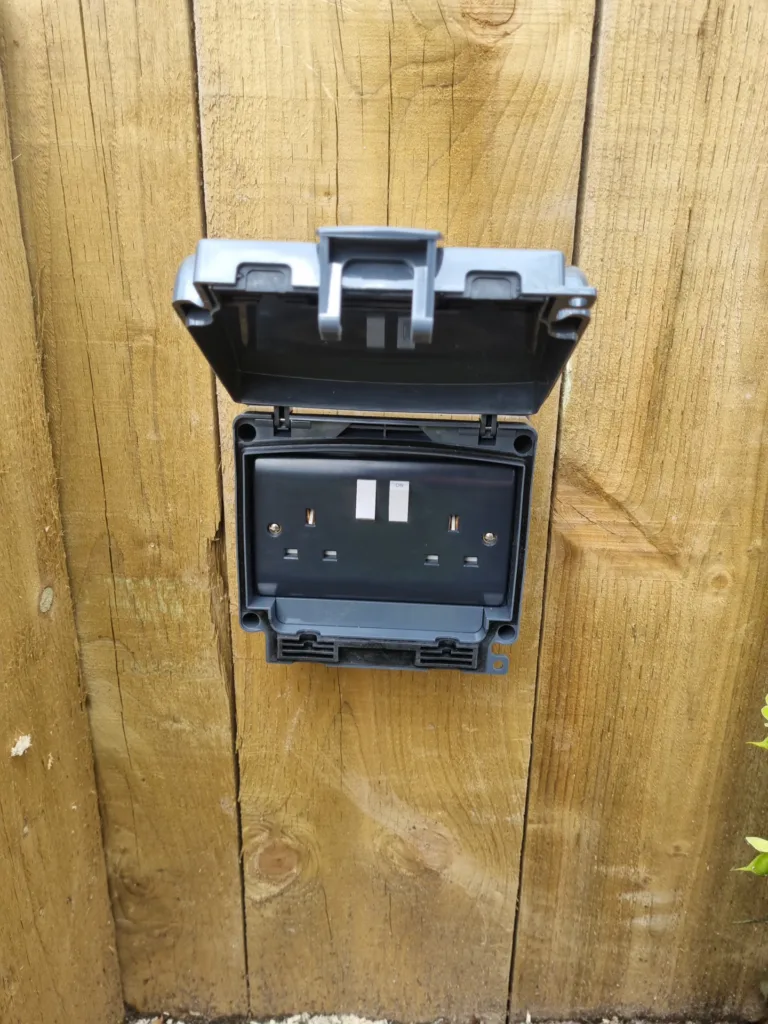
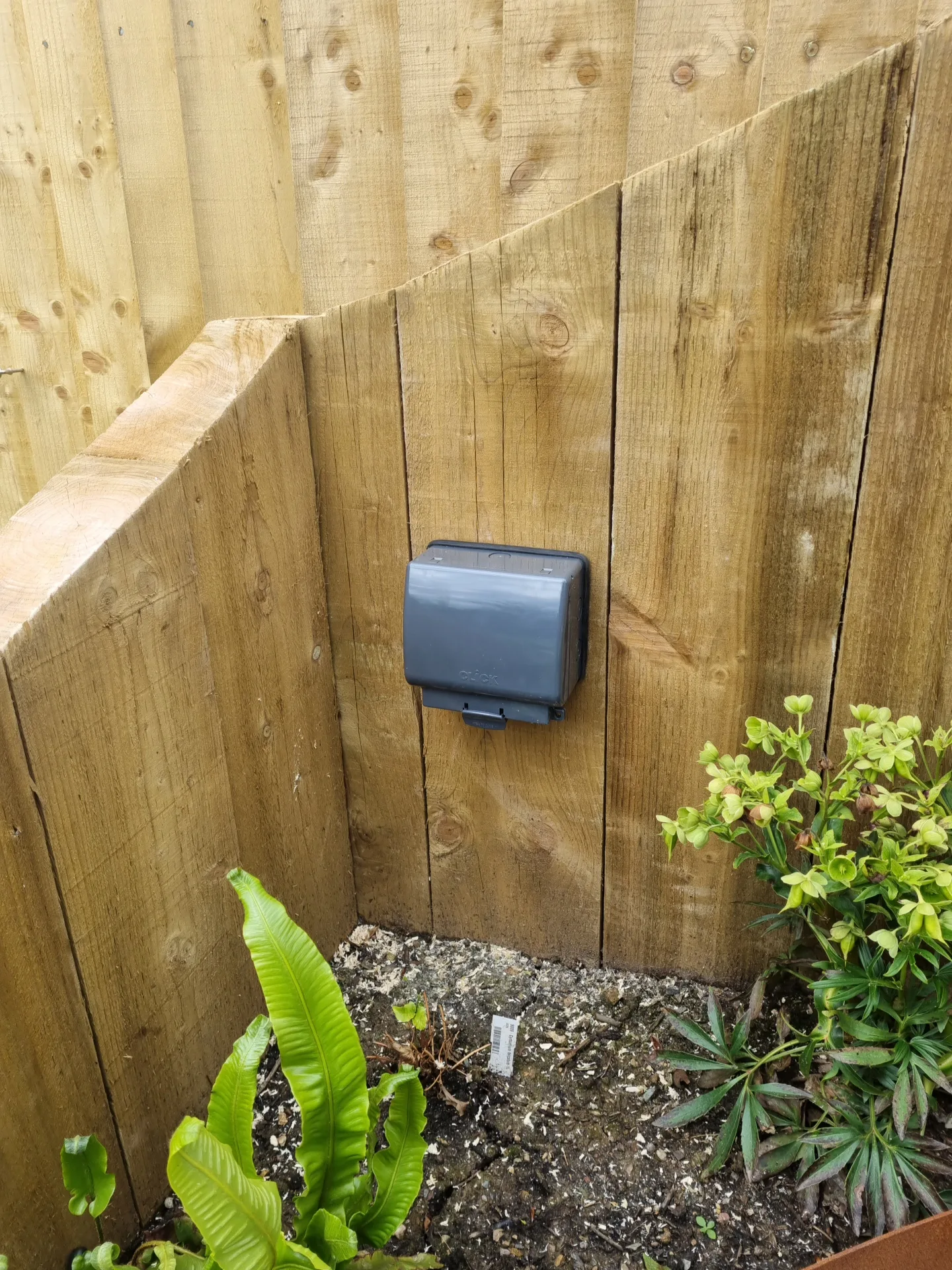
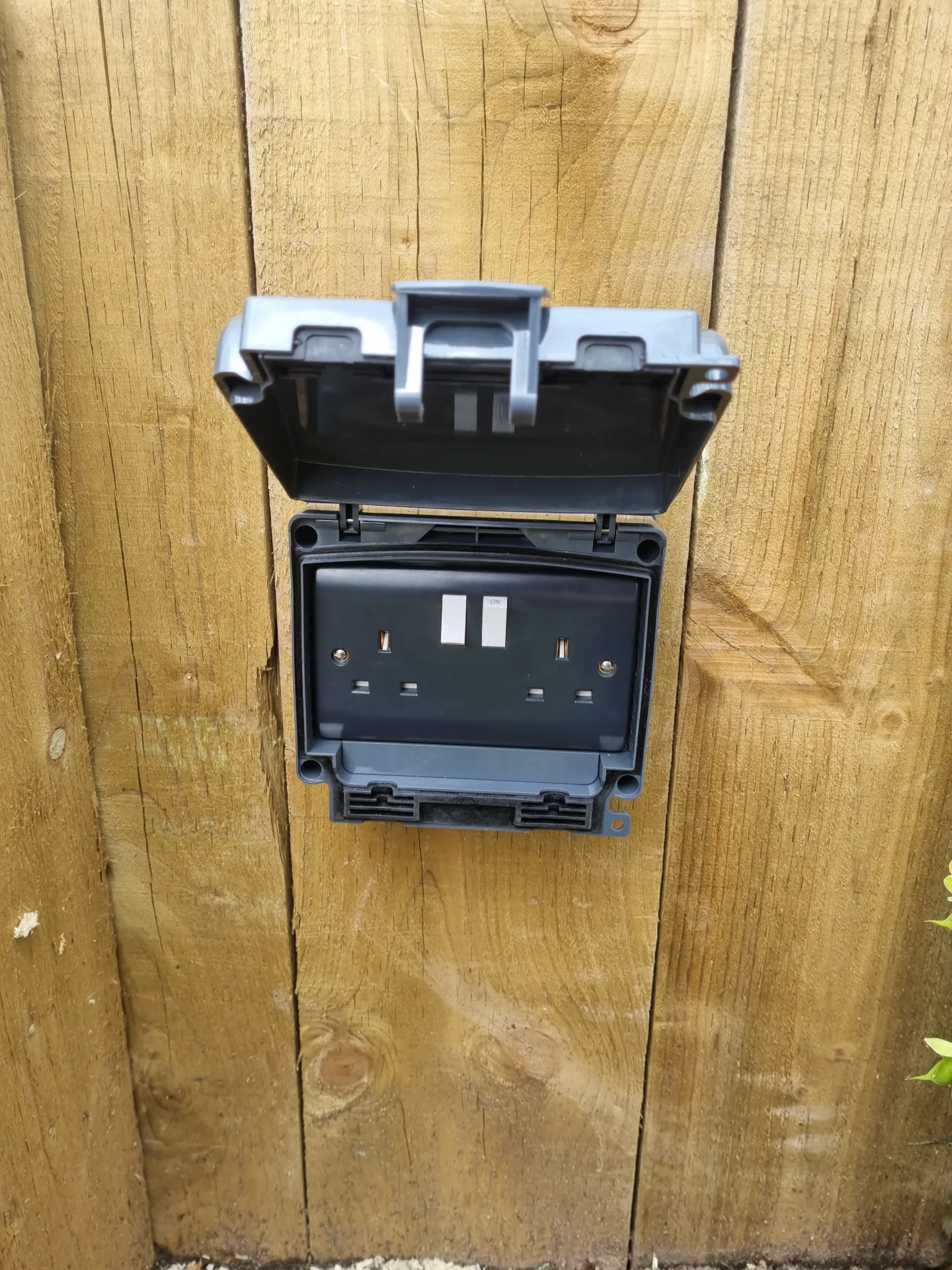
A rear garden in Playing Place needed a power point that wasn’t there before, somewhere secure enough to cope with sitting outdoors throughout the year. Rather than running an extension lead out from the house each time power was needed for tools, lighting or other equipment, we fitted a double socket exactly where it would be useful. Garden sockets like this get used for all sorts, from strimmers and hedge trimmers through to pond pumps or outdoor lighting, so having a fixed point rather than a temporary lead means power’s available at that spot whenever it’s wanted.
Rather than run an entirely new cable back to the consumer unit, we worked with the cable that was already there. That’s not something you assume will simply work, though. Before anything was connected, the existing cabling was checked for its condition, and its rating was verified against the extra load a new socket would place on it. So what does checking a cable like this actually involve? It generally means looking at the type of cable, its condition after however long it’s been in place, and what else might already be drawing from the same circuit inside the property. If a circuit’s already feeding several sockets or appliances, adding one more has to be weighed against what the whole circuit can safely carry, not just what the new socket alone would use. In this case, the cable checked out fine and was suitable to carry the extra socket without any changes needed elsewhere.
Had it turned out otherwise, with the cable in poor condition or its rating too low for the extra load, the fallback would have meant running an entirely new cable from the consumer unit instead. That’s a bigger job in itself, with more disruption involved in getting a new circuit through to the garden, which is exactly why checking first makes more sense than connecting up and hoping for the best.
The new double socket was fixed to the timber sleepers at the rear of the garden, giving it a solid, stable base. Timber sleepers tend to make for a sturdier fixing than something like a thinner fence panel, which can flex more over time and isn’t always ideal for mounting electrical accessories onto. Height and position mattered here too, since fitting a socket too low risks standing water or splashback reaching it, while somewhere awkward to get to rather defeats the point of having it there at all. Because the unit sits outdoors, it also needed to be built for those conditions, sealed well enough to keep moisture and general weather away from the connections behind it, which is standard for anything wired in outside.
With the new point fitted, the cable was connected back to an existing socket within the property, which now supplies power out to the garden. Wiring it this way meant there was no need for an additional circuit at the consumer unit, keeping the job more contained while still getting power exactly to where it was wanted, using capacity that was already available on the existing circuit rather than adding something new.
Once everything was wired in and fitted, we tested the whole circuit before signing the job off. That’s not just a case of switching it on to see whether it works. Testing at this stage checks the wiring is sound, the connections are secure, and that the circuit’s behaving correctly overall. Sockets fitted outdoors are treated a bit differently to those inside, mainly because of the added risk that comes with running electrics somewhere exposed to rain, damp ground and general weather. Beyond the enclosure itself keeping water out, a circuit supplying an outdoor socket is generally expected to have RCD protection, a safety device that cuts the power quickly if a fault’s detected, adding another layer of safety on top of the physical fittings. Testing checks all of that is in place and working as it should before anything gets handed over as complete.
The socket is now ready for use, whether that’s for power tools, garden lighting, a pond pump or anything else that needs plugging in without trailing a lead out from the house. Being a double rather than a single also means two things can run from the same point at once, without an extension block balanced somewhere outside to make that possible.