Getting a Mini Aceman Home-Ready in Saltash…
The brief came through simply enough. A son looking to sort out his mum’s home in Saltash after she’d picked up a new Mini Aceman – could we price up a home EV charger? It’s a scenario we’re seeing more and more. Someone takes the plunge with an electric car, realises fairly quickly that relying on public charging isn’t ideal, and decides a proper home charge point is the next logical step. Sensible thinking, and this project turned out to be a good example of what a well-planned installation actually involves.
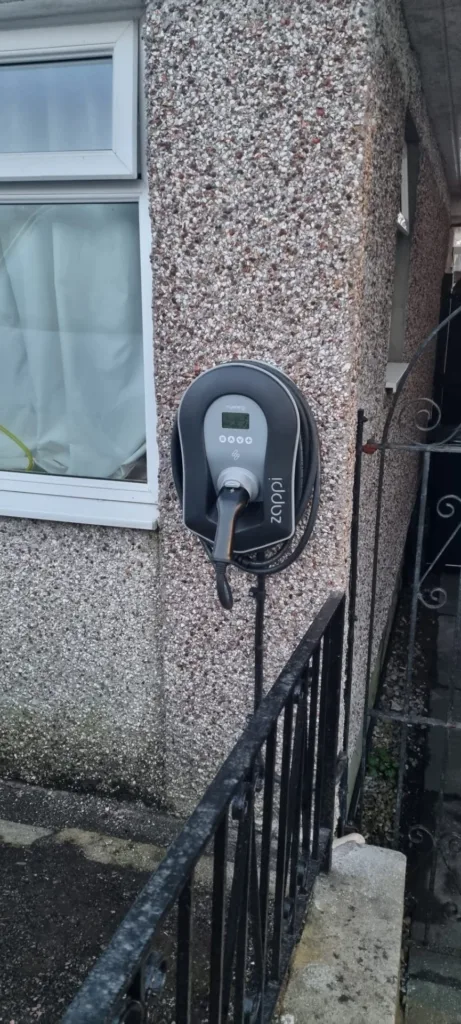
The charge point chosen was a MyEnergi Zappi, a 7.4kW tethered unit in black and grey, with a 5-metre charging cable permanently attached to the unit. The tethered setup suits most households well – you don’t need to carry a separate cable around or worry about it going missing. The Zappi itself is one of the smarter charge points on the market, with the ability to integrate with solar generation if that ever becomes part of the picture, as well as full app connectivity for scheduling and monitoring. It was mounted on the exterior wall at the front of the garage, which keeps the cable run practical and puts it right where it’s actually needed when parking up.
Before any of that could happen, the existing consumer unit had to go. It wasn’t in a position to safely support a 40A circuit for the EV charger, and frankly it wasn’t up to current standards anyway. We replaced it with a 7-way RCBO consumer unit fitted with an integrated Surge Protection Device. Each circuit in an RCBO board has its own individual protection, which means that if something trips, it affects only that circuit rather than knocking out half the house. The SPD handles something most people don’t think about – voltage spikes coming in from the grid. Those spikes are brief but they can cause real damage to modern electronics over time, so it’s a worthwhile addition, particularly in a property that’s now running a smart charge point.
The incoming meter tails were also upgraded to 25mm double-insulated cable as part of the consumer unit work, bringing everything in line with the 18th Edition wiring regulations. That sort of detail matters. A consumer unit replacement isn’t just a like-for-like swap – it’s an opportunity to bring the whole incoming supply arrangement up to scratch, and that’s exactly what we did here.
The cable supplying the Zappi runs from the new consumer unit, out under the side-pathway flagstones, and then clips along the garage side wall at low level before terminating at the charge point. Routing under the flags keeps things tidy and avoids surface-mounted conduit running across the path, which would look messy and create a trip hazard. The circuit is protected by a 40A bi-directional circuit breaker, which is the correct configuration for an EV charge point of this rating.
A load monitoring device was also installed as part of the setup. This is something worth understanding properly. A 7.4kW charger drawing full power alongside the usual household demand can push close to the limits of a standard domestic supply. The load monitor watches what the property is drawing overall and dials back the charger’s output if needed, rather than risking the main fuse operating. It’s not a limitation you’d notice in normal use – most EV charging happens overnight when household demand is low – but it’s there as a safeguard and it means the system behaves sensibly whatever else is running in the house.
Once installed, the Zappi was fully commissioned and paired to the app to confirm everything was operating correctly. It’s worth noting that any future re-pairing – if there’s a router change or the app needs resetting, for instance – falls outside the original installation scope and would be treated as a separate call-out. That’s standard across smart device installs and worth keeping in mind.
The third element of the job was a 10W LED floodlight fitted with an integrated PIR sensor, positioned centrally above the garage door. The supply was taken from the existing garage lighting circuit, with an isolator switch fitted inside the garage for local control. The positioning wasn’t accidental – having decent light above the garage door makes plugging in the car at night far more straightforward, especially during winter months. It also improves general security and visibility around the front of the property, which is a practical bonus.
On completion, electrical testing was carried out across all installed circuits to produce an Electrical Installation Certificate, and a Building Regulations notification was submitted for the consumer unit work. That notification is a legal requirement for this type of installation in England, and the certificate provides the homeowner with a formal record of the work carried out – useful for insurance purposes and if the property ever changes hands.
Taken together, the installation covered everything the property needed to charge the Mini Aceman at home safely and efficiently. From a straightforward initial enquiry to a fully tested, notified, and commissioned setup – it was a solid project from start to finish.