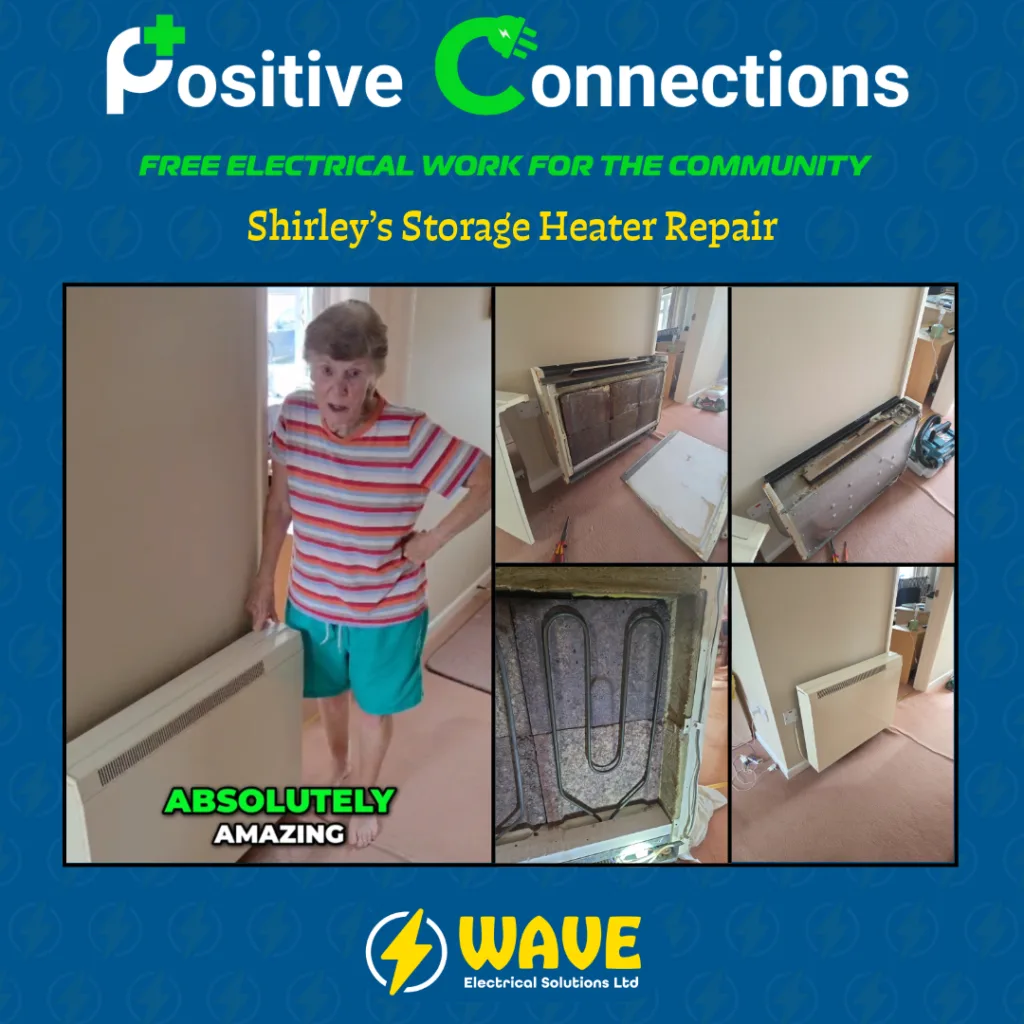
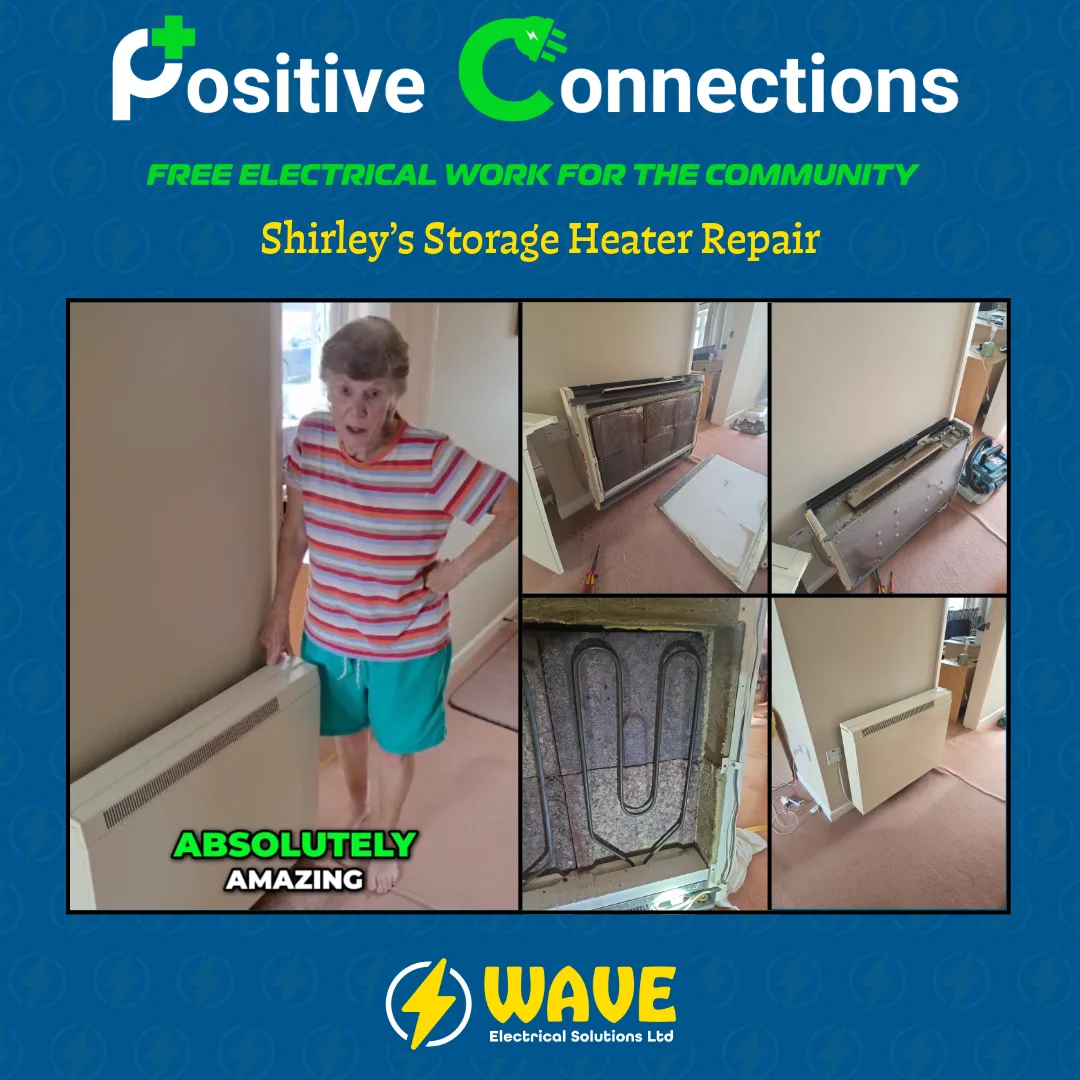
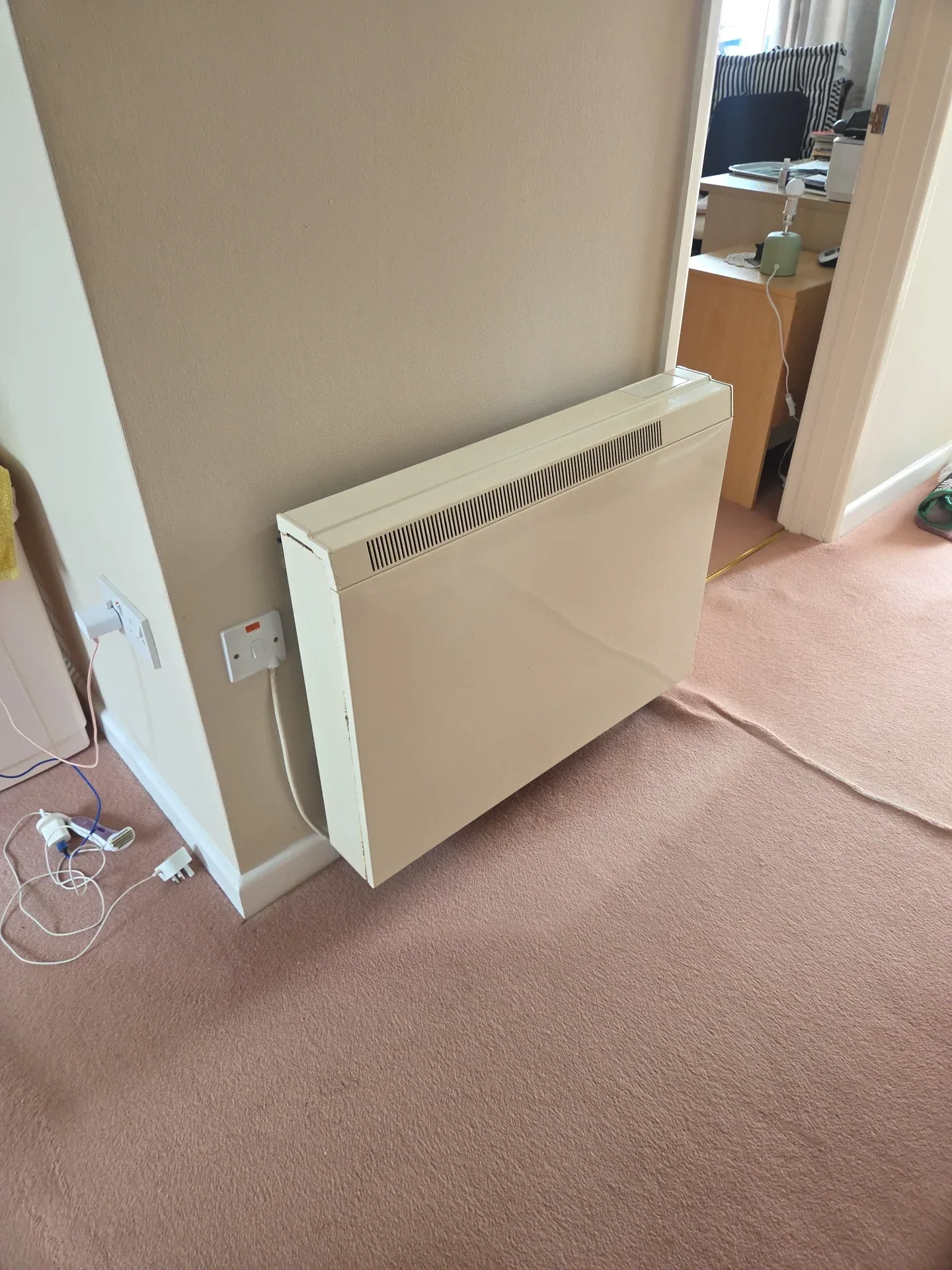
Storage heaters are one of those things you don’t think about until the morning you walk into a cold room and realise nothing’s happening. That’s where Shirley found herself over in Cubert. Her heater was sat there looking perfectly normal, but it wasn’t giving out a thing, and no amount of fiddling with the controls was going to change that.
For anyone not familiar with how these work, a storage heater charges itself up overnight on the cheaper off-peak rate, heating a stack of dense ceramic bricks inside the casing, then releases that heat slowly through the following day. It’s a simple idea and the older units are built like tanks, which is partly why so many of them are still in service decades after they were fitted. But simple doesn’t mean faultless, and when a heater goes cold there are usually only a couple of culprits worth looking at.
We took this one on under Positive Connections, our scheme offering free electrical work to elderly and vulnerable residents. Shirley wasn’t charged a penny for the heater repair, not for the visit, the parts or the labour. Heating sits pretty high up the list of things nobody should be going without, so this was exactly the sort of job the scheme exists for.
First thing was to isolate the supply and get the casing off. There’s no shortcut with these; the front panel comes away, then the bricks have to come out one at a time before you can get anywhere near the element. They’re heavy, dusty old things and it’s a bit of a workout, but it’s the only way to properly inspect what’s going on behind them. With the bricks out and set aside on a dust sheet, the element was visible running its loop across the back of the unit, and the thermal link was accessible too.
A quick word on the thermal link, because it’s the part most people have never heard of. It’s a safety device, and its whole job is to cut the supply permanently if the heater ever runs hotter than it should. It’s a one shot component, so once it’s gone, it’s gone. There’s no reset button and no way of nursing it back to life. That’s by design, because a storage heater that’s overheating is not something you want quietly carrying on regardless. The downside is that when a link blows, the heater looks completely dead, which understandably has people assuming the whole unit is scrap.
Testing confirmed what the symptoms suggested. There was no continuity across the thermal link, which told us straight away why no power was reaching the element, and the element itself wasn’t reading as it should either. So rather than swapping one part and crossing our fingers, both the element and the thermal link were replaced. It’s not worth doing half a job on these. Once you’ve gone to the trouble of emptying out all the bricks, fitting a fresh link alongside a new element costs very little extra and saves someone pulling the thing apart again in six months’ time.
With the new parts in, we tested again before anything went back together. Continuity was checked either side of the thermal link to confirm the circuit was complete and the new link was doing its job, and the resistance across the element was measured to make sure it fell within the expected range for the heater’s rating. Both readings came back where they needed to be. That’s the part of the job that doesn’t make for an exciting photo, but it’s the bit that actually matters, because it’s the difference between knowing a repair is sound and merely hoping it is.
While we were there, the flex feeding the heater was looking tired, so that was replaced as well. Small thing, but there’s no sense fitting new components inside the unit and leaving an old, worn cable supplying it.
Then the bricks went back in, the casing was refitted and we hit the usual hurdle with this sort of repair. Storage heaters are fed from an off-peak circuit that’s only live overnight, so in the middle of the day there’s nothing coming down the cable to test with. We could have packed up and told Shirley to let us know in the morning whether it had worked, but that’s not much use to anyone. Instead we temporarily relocated the circuit within the consumer unit so the heater could be energised there and then, which let us watch it come up to temperature properly and confirm the heat was spreading evenly across all the elements rather than just one section warming through. Once we were satisfied, the board was put back exactly as we’d found it and everything reinstated.
Shirley’s reaction when she felt the warmth coming off it was worth the drive on its own. She’d been convinced the heater was finished and that she’d be facing the cost of a replacement unit, which for a lot of people on a fixed income simply isn’t on the cards.
That’s the other side of this job that’s worth mentioning. A failed element and thermal link is a repairable fault, and repairing it is cheaper, quicker and a good deal less wasteful than ripping out a working heater and landfilling it. Plenty of these older units have years of service left in them as long as someone’s willing to open them up and look. Replacement isn’t always the answer, and we’d always rather fix something that can be fixed.
Everything was tested, the room was left tidy and Shirley had her heating back before we left. If you know someone elderly or vulnerable in Cornwall who’s struggling with an electrical problem they can’t afford to sort out, get in touch and tell us about them. Positive Connections is there for exactly that.